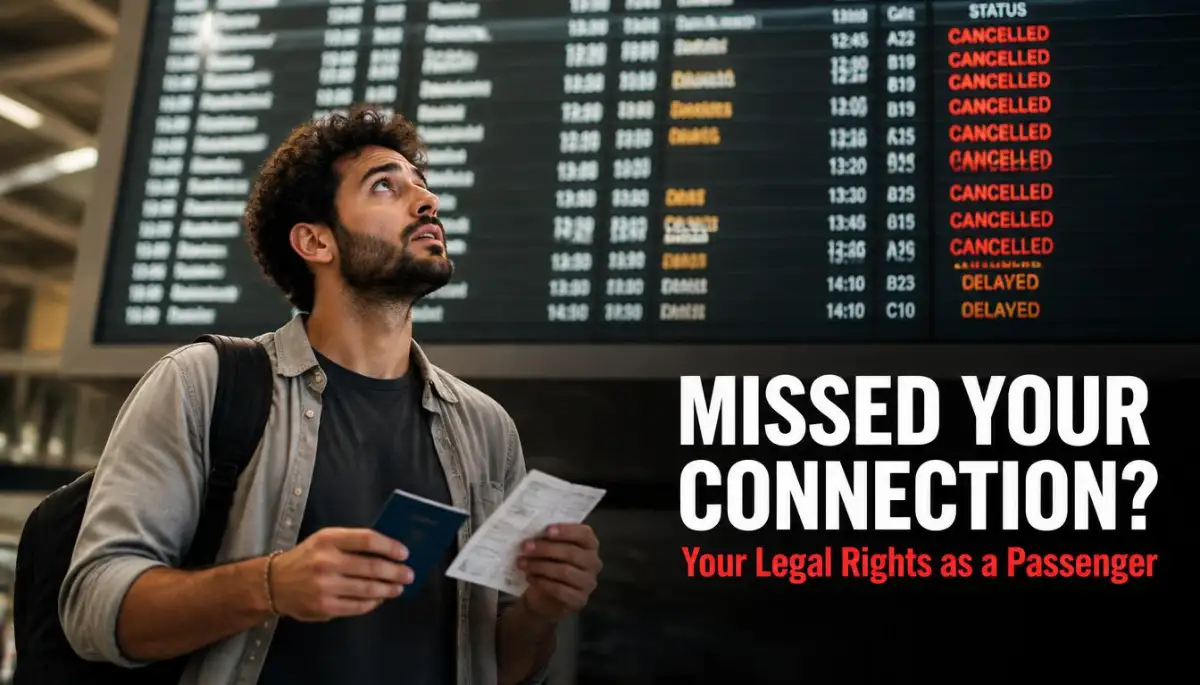
The Airport Chase: The Real Pain of a Missed Connection
Two years ago, I stood frozen at a boarding gate as my plane slowly backed away without me. I had spent my hard-earned savings on that trip, and suddenly, I was stranded in an unfamiliar city with only my backpack and a dead phone. That exhausting night, sleeping on a hard metal bench, I promised myself I would master the rules of air travel so no airline could ever take advantage of me again.
The sound of your own heavy breathing echoing through a cold, tiled airport terminal is a sound you never want to hear. You are sprinting past duty-free shops, clutching your heavy backpack, with sweat dripping down your face.
Your eyes are locked on the gate number on your crumpled boarding pass. You finally arrive, gasping for air, only to see the heavy glass doors closed shut and a red screen that reads: Gate Closed.
[ The Missed Connection Panic ]
                      │
            ┌─────────┴─────────┐
            ▼                   ▼
     💸 Empty Wallet      🏨 Stranded Alone
     (Expensive last-     (Sleeping on cold
      minute flights)      airport metal chairs)
Your stomach drops as the harsh reality sets in. Your heart sinks because you realize your family is waiting for you at your destination, your prepaid hotel room is going to waste, and your travel plans are completely shattered.
It is a moment of total helplessness, especially when you are stranded in a foreign country where you do not speak the language. The mental weight of trying to figure out where you will sleep, how you will eat, and how much this mistake will cost you is incredibly exhausting. Many people end up crying at the customer service desk or paying thousands of dollars for new tickets out of sheer panic. But you do not have to be one of them.
Knowing your rights changes everything. Let us look at how you can take back control of your trip and handle this situation like a seasoned traveler.
Smart Strategies to Navigate a Missed Connecting Flight
When you miss a flight, panic is your worst enemy. To get out of this situation without losing your mind or your money, you need to understand the hidden rules of the aviation world.
Check Your Ticket Type Instantly
Before you talk to any airline employee, you must understand how your tickets were purchased. The level of protection you have depends entirely on this single detail.
[ Ticket Types ]
                                │
             ┌──────────────────┴──────────────────┐
             ▼                                     ▼
     🎟️ Single Contract                     🎟️ Separate Bookings
   - Fully protected by law               - Zero airline liability
   - Airline rebooks you free             - You pay for new flights
   - Bags transferred automatically        - You must collect/recheck bags
If you bought your trip as a single journey with a connection on a single ticket, you are highly protected. The airline made a promise to get you to your final destination, and they must fulfill that promise.
If you bought two separate tickets from different airlines to save a few dollars, you are on your own. In the travel world, this is called a self-transfer, and the second airline has no legal duty to help you if your first flight was late.
Always look at your booking confirmation to see if you have one single booking code (PNR) for the entire journey. This single code is your shield against extra costs.
The Action Plan for Your First Ten Minutes
If you have just missed your flight, do not wander around the terminal aimlessly. You need to take three specific actions immediately to secure your spot on the next plane.
First, find the airline's customer service desk immediately inside the transit area. Do not exit the security zone yet, as the line inside is usually much shorter than the ticket counter line in the main lobby.
Second, open your airline’s mobile app on your phone. Many modern airlines now allow you to rebook yourself onto the next available flight with a single tap, completely bypassing the physical lines.
Third, take photos of your original boarding passes and keep them in a safe folder on your phone. These documents are proof that you checked in on time and are essential if you want to claim compensation later.
Master Your Regional Passenger Rights
The rules that protect you vary wildly depending on where you are flying and which airline you are using. Knowing these regional differences can save you thousands of dollars.
Introductory Text (To be bolded and placed right above the video): Need a quick and simple visual guide to make sure you get your money back? Watch this highly helpful video to see exactly how these passenger laws protect you, and then keep reading below to avoid the sneaky mistakes that can cost you thousands!
Understanding the Power of EU 261 and UK 261
If your flight departs from an airport in the European Union or the UK, or is operated by an EU/UK airline, you are protected by some of the strongest laws in the world. If you miss your connection because of a delay on your first flight, the airline must take care of you.
They must provide you with food vouchers and free phone calls while you wait. If the next available flight is the next day, they must pay for a hotel room and provide free transport to and from that hotel.
If you arrive at your final destination more than three hours late, you are often entitled to cash compensation This cash payout can range from €250 to €600 depending on the distance of your flight
The Reality of Flying Within the United States
The rules in the US are very different from Europe. The US Department of Transportation does not force airlines to pay cash compensation for delayed flights or missed connections.
However, major airlines have signed customer service commitments. If the delay is the airline's fault (like a mechanical breakdown), they will usually rebook you on the next flight for free and provide meal vouchers. Always check the airline’s customer service dashboard online to see what they have officially promised to provide.
Myth vs. Reality: The Missed Connection Edition
- Myth: Airlines will always pay for your hotel if a storm causes you to miss your flight.
- Reality: Airlines are never responsible for bad weather, volcanic ash, or air traffic control strikes. If "extraordinary circumstances" cause the delay, you must rely on your travel insurance for hotel costs.
- Myth: You must accept a travel voucher instead of cash if the airline offers it.
- Reality: Airlines love to hand out vouchers, but under EU and UK law, you have a right to receive cash. Never sign a waiver accepting a low-value voucher unless you are sure you want it.
Pro Tip: The Secret International Calling Trick
When a flight is canceled, hundreds of passengers run to the customer service desk. This creates massive lines where you might wait for three hours just to speak to an agent.
                ┌──────────────────────┴──────────────────────┐
                ▼                                             ▼
       🚶 Stand in Line                                📞 Phone Hack
    (Wait 3+ hours at desk;                         (Call international support;
     seats on next flight fill up)                   speak to agent in 5 minutes)
Instead of standing in that line, call the airline's international support number in another country. For example, if you are flying with a US airline, call their UK, Australian, or Canadian customer support line.
These foreign call centers speak perfect English, have almost no wait times, and can rebook you onto the next flight while you are still walking toward the service desk.
During my first major flight delay, I spent two painful hours standing in a slow customer line before I realized I could just call the airline's international help desk. It was a massive wake-up call that completely changed how I handle travel stress. Now, I never waste my energy in airport lines; I let my phone do the running for me while I sit back and relax.
I have used this trick multiple times, and it is the fastest way to secure the last remaining seats on the next plane out.
Tracking Your Luggage: Where Does Your Bag Go?
One of the biggest worries during a missed connection is what happens to your checked bags. Will they wait for you, go to the final destination, or get lost in the airport basement?
If you booked your trip on a single ticket, your bags are tagged directly to your final destination. When you miss your connection, the airline's ground crew will automatically try to locate your bag and move it to your new flight.
However, if your new flight is many hours later, your bag might be stored in the airport's secure hold. When you finally arrive at your final destination, always check the baggage claim area first.
If your bag does not appear, immediately go to the baggage services office and fill out a Property Irregularity Report (PIR) before you leave the airport. This paper is proof that the airline lost your bag and is required for any future reimbursement.
Navigating the Human Side: Dealing with Gate Agents
It is easy to get angry when you are tired and stressed, but yelling at the gate agent is a terrible strategy. These workers do not cause the delays, but they hold the power to help you.
Be incredibly polite, calm, and cooperative. Use phrases like, "I understand this is a busy day for you, but I need your help to find a solution."
A friendly passenger who stays calm is much more likely to get a free meal voucher, a better seat on the next flight, or a hotel room. Treat the agents as partners in solving your problem, and you will be amazed at how much faster your travel nightmare disappears.
Smart Transit Strategies: Protect Your Rights Before Your Wheels Leave the Ground
The secret to surviving a missed connection starts long before you pack your bags. Smart travelers do not just hope for the best; they build a shield of safety before they ever step foot in the airport.
One of the most important metrics you must check when booking a flight is the Minimum Connection Time (MCT). This is the official, legally agreed-upon amount of time an airport requires for a passenger to walk from one gate to another.
Airlines often sell tight connections that technically meet the MCT but are practically impossible to catch if your first flight is even ten minutes late. When you book a transit flight, always look for a connection window of at least two hours for domestic flights and three hours for international travel.
[ Connection Security Windows ]
                      │
            ┌─────────┴─────────┐
            ▼                   ▼
     ✈️ Domestic Flights  🌎 International
     (Minimum: 2 Hours)  (Minimum: 3 Hours)
Travel disruptions can trigger massive physical and emotional exhaustion. If you are already dealing with high levels of professional or personal stress, a sudden flight delay can push you over the edge.
In those tough moments, knowing how to recover your mental peace is just as important as overcoming college burnout during heavy academic seasons. Both situations require you to take a step back, breathe, and follow a clear, structured plan to regain control.
Another great strategy is to keep an active digital folder of all your travel documents on your phone, which must be accessible offline. This folder should hold your e-tickets, boarding passes, travel insurance policy, and a clear copy of your passport.
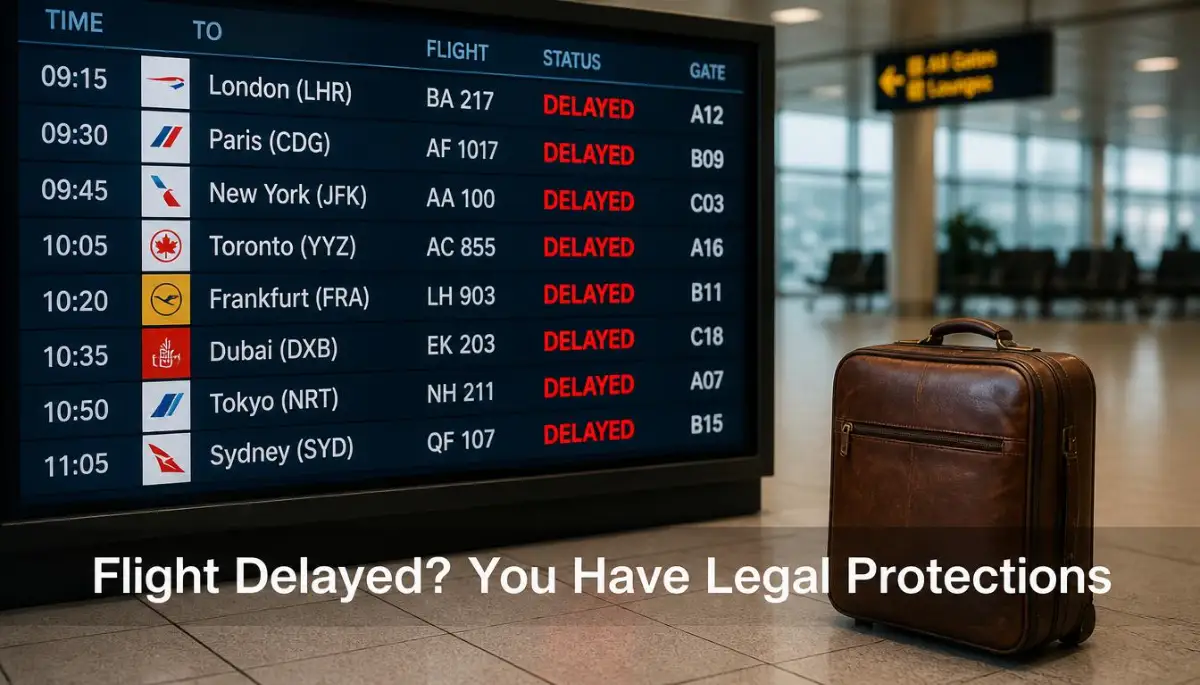
If your flight is delayed, take a quick photo of the airport departure screen showing the delay next to your flight number. This photo serves as permanent proof of the incident if the airline later claims the flight was on time. You also need to understand the financial side of travel delays. If you are planning to travel during a major life transition, like switching careers, you must protect your money from unexpected hotel and food costs.
For example, learning how to manage your finances during a job change during mortgage application can keep your long-term plans safe, just as having a solid travel insurance policy protects your wallet when an airline leaves you stranded. Both require you to look ahead and prepare for the unexpected.
To ensure you get the help you deserve, you can check the official rules outlined by the US Department of Transportation Aviation Consumer Protection portal. This resource explains the baseline commitments that carriers must provide to delayed passengers.
The Sneaky Pitfalls That Cost Stranded Passengers Hundreds of Dollars
When you are tired and stuck in an airport terminal at midnight, it is easy to make quick decisions that you will regret later. Airlines know this, and their staff is trained to protect the company's budget, not yours.
The biggest mistake you can make is accepting the very first travel voucher the airline offers you without reading the fine print. These vouchers often come with a hidden legal waiver. By signing the paper or clicking "accept" on your phone, you might be giving up your legal right to cash compensation.
[ The Voucher Trap ]
                               │
             ┌─────────────────┴─────────────────┐
             ▼                                   ▼
      🎟️ Travel Voucher                    💵 Cash Claim
  - Expires quickly                   - Real money in hand
  - Has blackout dates                - No annoying restrictions
  - Waives your legal rights          - Protected by transport laws
Always ask the gate agent directly: "Does accepting this voucher forfeit my right to claim cash compensation under passenger rights laws?" If they say yes, or if they refuse to answer clearly, politely decline the voucher and ask for your options in writing.
Another massive mistake is walking out of the security gate or leaving the transit zone too early. Once you step out of the secure area to the main lobby, you cannot easily go back in without waiting in long check-in lines again.
Keep your physical place inside the transit area until you have a confirmed seat on a new flight.
Additionally, never leave the airport without a Written Confirmation of Delay from the airline staff. If an agent promises to pay for your taxi or hotel room, make sure they write it down on an official airline paper with their signature.
Without this paper trail, the airline's billing department can easily reject your refund claim once you get back home.
If you have to take legal action against an airline for unpaid claims, you might need to understand basic civil procedures. This process is very similar to the logical steps you must follow if you are ever served with a civil lawsuit.
In both cases, having clear documentation, keeping a calm head, and meeting exact deadlines will help you win your case.
To know your exact rights when flying through European airports, you can read the detailed passenger guides on the European Commission Air Passenger Rights website. This portal outlines the exact monetary values you can claim based on the distance of your journey
┌──────────────────────────────────────┐
                 │       THE STRANDED PASSENGER PATH    │
                 ├──────────────────┬───────────────────┤
                 │      DO THIS     │     AVOID THIS    │
                 ├──────────────────┼───────────────────┤
                 │ Keep screenshots │ Sign fast waivers │
                 │ of delay screens │                   │
                 ├──────────────────┼───────────────────┤
                 │ Stay inside the  │ Exit the transit  │
                 │ transit zone     │ security gate     │
                 ├──────────────────┼───────────────────┤
                 │ Get written      │ Believe verbal    │
                 │ staff promises   │ airline promises  │
                 └──────────────────┴───────────────────┘
Your Step-by-Step Action Plan for Tomorrow: Travel with True Peace of Mind
At the end of the day, travel disruptions are simply a part of seeing our beautiful world. They are not a personal attack on you, and they do not have to ruin your entire travel experience.
By changing your mindset from a worried passenger to an informed consumer, you turn a stressful delay into a simple, manageable process.
The next time you book a flight, do not just hope for a perfect journey. Instead, pack your digital folder with your rights, choose your connection times wisely, and keep a cool head if things go wrong.
You now have the knowledge to stand tall at the customer service desk, look the agent in the eye, and ask for exactly what the law says you deserve. Use these tips on your very next trip, share this guide with your friends who love to travel, and step onto your next plane with the calm confidence of a true travel expert.
My own travel mistakes have taught me that we cannot prevent every single delay, but we can completely change how we handle them. Once I learned to stand up for my rights, airport panic lost all of its power over me. I want you to have that same peace of mind, so you can focus on the pure joy of exploring our world.
Disclaimer: This article is for educational and informational purposes only. Air passenger rights can vary based on your specific airline ticket contract, country of departure, destination, and the exact cause of your flight delay. For legal advice regarding a specific claim or dispute with an carrier, please consult a legal professional or contact your local aviation authority directly.