
The Sudden Knock: Facing the Reality of a Legal Summons
Imagine coming home after a long, exhausting day at work. You are looking forward to a quiet dinner and some rest. Suddenly, there is a loud, unexpected knock on your front door.
You open it and a stranger hands you a thick packet of papers before quickly walking away. Your eyes scan the front page, and the word 'Summons' jumps out at you in bold letters. In that single moment, your peaceful evening completely evaporates. A wave of intense anxiety washes over you, making your heart race. Your mind floods with scary thoughts about losing your savings, your home, or your peace of mind.
This sudden panic is something thousands of regular people experience every single day. The legal system can feel like a cold, confusing machine designed to overwhelm you. Looking at complex legal terms makes you feel completely lost and helpless.
You might lie awake for hours, staring at the ceiling and wondering how this will affect your family. But you do not have to let this fear paralyze you.
While getting served is highly stressful, it is simply a legal notice, not a final judgment. By taking a few clear, deliberate steps right now, you can regain control of your situation.
Your Immediate Action Guide: Taking Control of the Situation
When you receive a lawsuit, fear often breeds misinformation. Let us clear up some of the most common myths so you can proceed with a clear head.
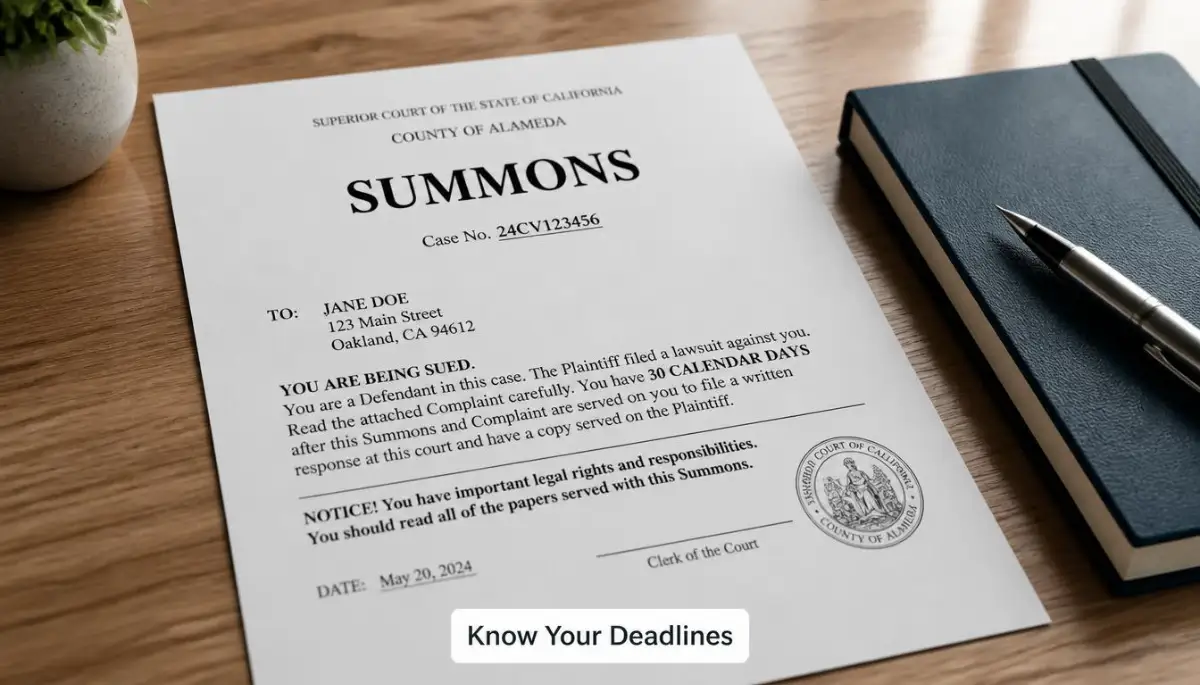
First, you need to find out exactly how much time you have to respond to the papers. Every civil lawsuit has a strict time limit, which is usually twenty or thirty days. If you miss this window, the person suing you can win the case by default.
Do not guess this date or leave it to memory. Grab a bright calendar and circle the deadline with a red marker. Set multiple digital alarms on your phone to remind you as the date approaches.
Remember that counting the days can be slightly tricky depending on your local state laws. Sometimes weekends and holidays do not count, while other times they do. Checking with your local court clerk can help you find the exact calendar date.
It is completely natural to want to hide these papers in a desk drawer. However, ignoring the paperwork will only make things much worse. Sit down at a clean table with a cup of tea and read through the entire packet page by page. Look closely at the names listed on the first page of the document. The plaintiff is the one bringing the lawsuit, and you are the defendant. Make sure the papers actually belong to you and not a neighbor with a similar name.
Next, look for the specific court where the case is filed. This is important because you will need to file your response in that exact location. Note down the case number as you will need to write it on every paper you submit. You might feel a strong urge to call the plaintiff and explain your side. You might think you can clear up the misunderstanding with a quick phone call. However, this is one of the biggest mistakes you can make.
Anything you say to them can be written down and used against you in court. They are not looking to help you; they are building a case. Keep your conversations limited to formal, written court filings.
If they try to call you, politely tell them that you will only communicate in writing. This protects you from accidentally saying something that hurts your defense. Let the official court process handle the talking. Now is the time to gather every piece of proof that supports your story. Look for emails, text messages, receipts, bank statements, and written agreements. Put all of these items into a single secure folder.
Make digital copies of all these documents as well. Store them in a safe cloud drive so you do not lose them if your phone or computer breaks. Having organized files makes it much easier to defend yourself. Write down a timeline of events while the details are still fresh in your mind. List dates, times, and what happened during each interaction. This document will act as your personal roadmap when drafting your response.
To stop the plaintiff from winning automatically, you must file a written answer. This is a formal document where you respond to each allegation in the complaint. You can agree, deny, or state that you do not have enough information to answer.
Keep your answers short and to the point. You do not need to explain your entire life story in this paper. Simple denials are often the best way to protect your rights at this stage.
Many court websites offer free templates that you can download and fill out. Look for the specific form labeled 'Answer to Civil Complaint' on your local court site. This makes the drafting process much easier.
An affirmative defense is a legal reason why you should not be held responsible, even if the plaintiff's facts are true. For example, if too much time has passed since the event, the statute of limitations may have expired Another common defense is that you never received the papers properly. If the delivery person simply left them on your lawn, the service might be invalid. Listing these defenses in your answer is important because you cannot bring them up easily later.
Take some time to research common defenses for your specific type of lawsuit. Knowing your rights can give you a major advantage in court.
Once your answer is ready, you must file it with the court clerk. Take the original document and at least two copies to the courthouse. The clerk will stamp them and keep the original for the case file.
You must also send a copy of your answer to the plaintiff or their attorney. This is called 'serving' your response, and it must be done properly. Always keep a stamped copy of the answer for your personal records. Make sure you get proof of mailing or delivery when you send the copy. If the other side claims they never got it, your receipt will prove otherwise.
You might think hiring a lawyer is far too expensive for your budget. However, there are many low-cost or free resources available to help you. Many lawyers offer a free initial consultation to discuss your case. Look for local legal aid organizations in your city. These groups provide free legal help to low-income individuals facing civil matters. They can help you draft your paperwork or offer valuable advice.
You can also visit a local law library. The librarians there cannot give legal advice, but they can guide you to the right books and forms. Using these free tools can save you thousands of dollars.
Failing to respond to a summons has severe consequences. If you do nothing, the judge will issue a default judgment against you. This means the plaintiff wins the lawsuit without ever having to prove their case. Once they have a judgment, they can take legal steps to collect the money. They might garnish your weekly paycheck or freeze your bank accounts. This can ruin your financial stability for a very long time.
Taking action now is much easier than trying to undo a default judgment later. Even a simple, one-page answer keeps the door open for a fair hearing. Think of it like tending to a small leak in your roof. Fixing it today is simple, but waiting will destroy your entire ceiling. As your case moves forward, keep a detailed journal of everything that happens. Write down the dates of every phone call, letter, and court appearance. Note who you spoke with and what was discussed.
This simple habit keeps you organized and reduces your daily stress. It ensures you do not forget important details as the weeks go by. Having a clear record can be incredibly helpful if you need to show the judge what happened.
Keep this journal in your legal folder along with your evidence. This keeps all your important information in one easy-to-reach place.
Filing an answer does not mean you have to go to trial. Most civil cases are actually settled out of court long before a trial begins. You can look into mediation, where a neutral third party helps both sides reach an agreement.
Mediation is often much faster and cheaper than going through a full court battle. It allows both sides to find a compromise that works for everyone. Keep this option in mind as you plan your strategy. A settlement can resolve the issue quietly and let you move on with your life. It is often the best way to find peace of mind quickly.
Smart Defense Strategies and Hidden Tools
Many people do not realize that the person suing you bears the entire burden of proof. In many debt collection cases, the company suing you bought your debt from another bank for pennies. They often lack the original paperwork required to prove you actually owe them money
You have the legal right to demand original contracts and payment histories during the initial stages. If they cannot produce these papers, the judge may dismiss the case entirely. Always force the other side to prove every single claim they make in their complaint. If you are sued for a vague debt, you can ask for a formal itemized list of charges. This legal document is often called a Bill of Particulars. It forces the creditor to show how they calculated the exact amount they claim you owe.
Often, they have added high interest rates and hidden fees that they cannot legally justify. When you request this breakdown, it often slows down their aggressive legal clock. This extra time allows you to prepare a stronger defense or seek legal help. Legal battles can be expensive, and they often catch you completely off guard. Having cash on hand to pay for filing fees or quick attorney consultations is highly useful. If you find yourself struggling to find the money, you might need to adjust your personal savings habits.
Learning how to build a bulletproof emergency fund fast can save you from borrowing high-interest money during a crisis. A small cash reserve keeps you from making rushed, desperate choices. It gives you the breathing room to fight the lawsuit with confidence.
Many county courts now offer free mediation programs directly inside the courthouse. These programs are designed to help ordinary citizens settle disputes without going through a long, stressful trial. A neutral mediator will sit down with both sides to help you reach a fair agreement.
This process is usually much less formal and takes only a few hours of your day. You can find detailed information about these resources on official state court portals like the California Courts Self-Help Center Taking advantage of these free programs can save you both time and energy.
Once you file your answer, the case enters a phase called discovery. This is a formal process where both sides must share their evidence with each other. You can use this phase to ask the plaintiff for specific documents, emails, or witness statements. If they refuse to share this information, they cannot use it against you during the trial. Many debt buyers do not have these papers and will drop the case rather than search for them. Knowing how to use discovery is a major secret that lawyers use to win cases.
Every courthouse has its own unique set of rules, often called local rules. These guidelines tell you exactly how to format your papers, where to file them, and how to behave in front of the judge. Skipping one of these minor rules can cause the clerk to reject your paperwork. Fortunately, most courts post their local rules online for anyone to read. You can also visit the courthouse in person and ask the clerk for help. While they cannot give you legal advice, they can explain the filing process clearly.
If your case does not settle, the judge will schedule an initial hearing. This is not the actual trial, but rather a quick meeting to plan the next steps of the case. You should dress neatly, arrive early, and bring your organized folder of evidence.
Address the judge respectfully as "Your Honor" and only speak when you are asked a question. Avoid interrupting the plaintiff or their lawyer, even if they say things that are completely untrue. The judge will give you a fair turn to present your side of the story.
- Do keep every single envelope and piece of mail that the court or the plaintiff sends you.
- Do write down the names of everyone you speak with at the courthouse.
- Don't accept verbal promises from the plaintiff without getting them in writing.
- Don't miss your scheduled court dates, even if you think the case is already resolved.
Sometimes, a lawsuit has major legal flaws from the very beginning. For example, the plaintiff might have filed the case in the wrong county or waited too many years to sue you. In these situations, you can file a formal request called a Motion to Dismiss.
This motion asks the judge to throw out the case without even looking at the evidence. It is a powerful tool because it can end the lawsuit before it truly starts. However, you must research your local rules carefully to make sure you have valid grounds.

Invisible Traps That Can Ruin Your Case
The absolute biggest mistake you can make is doing absolutely nothing. When the sheriff or process server hands you those papers, the clock starts ticking immediately. Many people freeze up because they feel ashamed or terrified of the situation. They leave the legal documents sitting on their kitchen counter, hoping the problem will magically disappear. Unfortunately, the legal system does not care about your fears or your busy schedule. Doing nothing is an automatic win for the person suing you, which can lead to wage garnishment.
This situation often begins when a simple financial slip-up gets completely out of hand. For instance, understanding what happens if you miss a personal loan emi payment and how to fix it can prevent these problems from turning into lawsuits. Taking early action is always the best way to protect your hard-earned money.
Sometimes, the plaintiff's lawyer will call you to offer a quick, friendly settlement over the phone. They might promise to drop the lawsuit if you make a small payment right away. It is incredibly tempting to trust their word just to end the stressful situation. However, you must never agree to anything without receiving a signed, written contract first. If you send them money without a formal agreement, they can still go to court and get a judgment against you. Always protect yourself by getting every single promise in writing before you pay a single dime.
You can learn more about your rights when dealing with debt collectors from official resources like the Consumer Financial Protection Bureau Knowing the laws protects you from deceptive tactics that could drain your bank account.
When you are stressed, you might feel the need to explain your financial hardships to the plaintiff. You might tell them that you want to pay but simply do not have the funds right now. While this sounds like an honest conversation, you are actually handing them evidence.
Admitting that you owe the money makes it incredibly easy for them to win the case. Keep your conversations brief and let your formal legal answer do the speaking. Never apologize or admit to any debt unless you are doing so in a formal, signed settlement. When you send your formal answer to the plaintiff, you must prove to the court that they received it. This process requires you to file a separate paper called a Proof of Service. Many people forget this simple step, which can cause the court to ignore their answer.
Always use certified mail with a return receipt when sending papers to the plaintiff's lawyer. This receipt is your physical proof that they received your defense papers. Keep this receipt safely tucked inside your dedicated case folder.
Your Clear Path to Peace of Mind
Receiving a lawsuit summons is undoubtedly one of the most stressful events you can experience. However, it is important to remember that this is simply the beginning of a process, not the end. You have the power, the rights, and the tools to stand up and defend yourself. By staying organized, respecting the court deadlines, and avoiding simple traps, you can navigate this storm successfully. Do not let fear dictate your actions or steal your sleep. Take a deep breath, review your papers, and start building your defense plan today.
If you are facing multiple debts that seem completely overwhelming, there are ways to clean up your financial life. Exploring options like how to consolidate multiple debts without hurting your credit score can help you rebuild your path. Taking small, positive steps today will lead to a much brighter and more stable future.
You are not alone in this journey, and help is always available if you look for it. Trust the process, keep your head high, and take action right now. Your future self will thank you for the courage you show today.
Disclaimer: The information provided in this article is for educational purposes only and does not constitute formal legal advice. Please consult with a qualified attorney in your jurisdiction for advice regarding your specific legal situation.