
The Frustrating Mystery of the Disappearing Fuel
Last month, I watched my bank account slowly drain because of my old sedan. I was visiting the gas station three times a week, and the constant spending made me feel completely helpless. I finally learned my lesson about car maintenance the hard way, and I want to share my personal experience so you do not have to go through the same stressful struggle.
You pull up to the gas station. Again. It feels like you were just here a few days ago. You look at the price ticking upward on the pump, and your stomach sinks.
You did not change your driving habits. You did not go on any long road trips. Yet, your gas tank is emptying faster than ever before. This is the silent mental drain that millions of car owners face every single day.
Then, the check engine light pops up on your dashboard. You feel a sudden wave of anxiety. Is your engine about to fail? Will this repair cost thousands of dollars?
Most people try to ignore the light, hoping it will just go away. But ignoring this specific warning is like throwing cash directly into your exhaust pipe. Your car is quietly burning through extra fuel, and you are paying the price at every single pump.
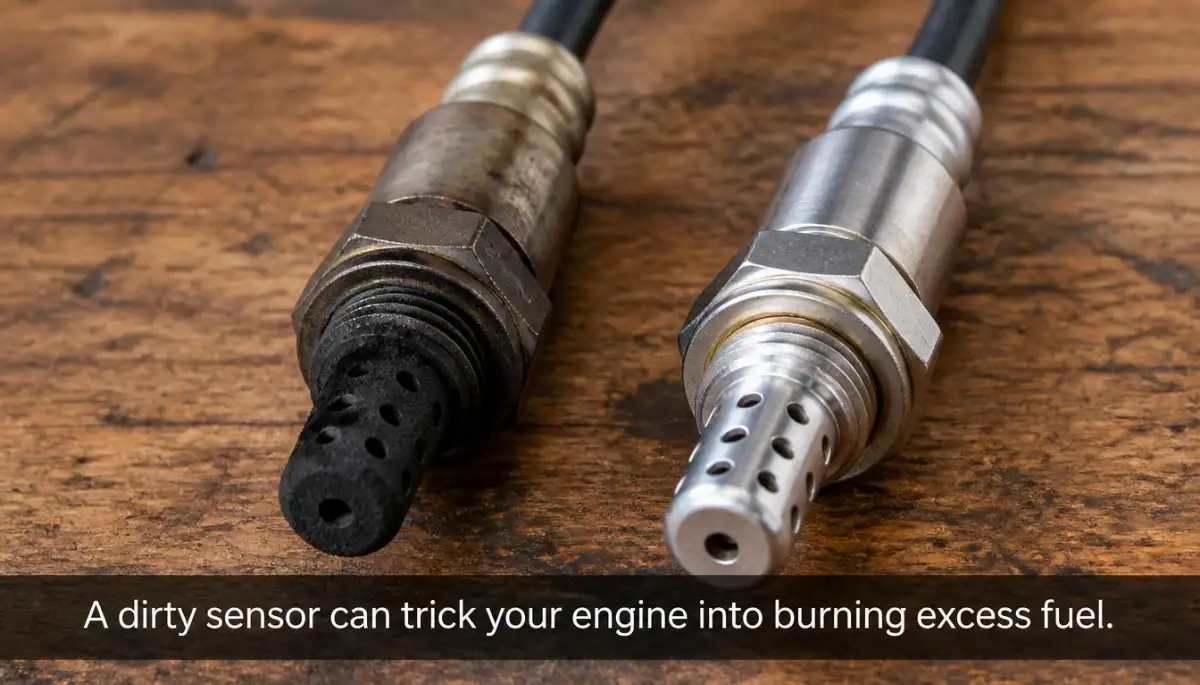
The culprit behind this mystery is often a tiny, overlooked metal plug located deep under your car. It is called the oxygen sensor, and when it fails, it quietly sabotages your vehicle's performance.
The Nose of Your Engine: How the O2 Sensor Works
To understand why your car is suddenly guzzling fuel, we must look at how an engine breathes. Your car engine is essentially a giant air pump. It mixes oxygen with gasoline and ignites the mixture to create power.
But the engine cannot just guess how much fuel to use. It needs constant, real-time data to make the perfect mixture. This is where the oxygen sensor comes into play. Think of this sensor as the nose of your car. It sits inside the exhaust pipe, constantly sniffing the gases that leave the engine. It measures how much oxygen is left over after the fuel burns.
If there is too much oxygen, the engine is running "lean," meaning it needs more fuel. If there is too little oxygen, the engine is running "rich," meaning it is burning too much fuel.
Every second you drive, this tiny sensor sends hundreds of electrical signals to your car’s main computer. The computer uses these signals to adjust the fuel injectors. When the sensor is healthy, your car runs clean, smooth, and highly efficient.
What Happens When the Sensor Goes Blind?
Over time, your engine’s nose gets clogged. High heat, carbon buildup, and old age take a heavy toll on the sensor's delicate tip. When the oxygen sensor gets coated in black carbon soot, it can no longer accurately read the exhaust gases. It essentially goes blind.
To protect the engine from running too hot, the car's computer defaults to a safe mode. This safe mode is known as running "rich."
When your car runs rich, the computer pumps a massive amount of excess fuel into the engine cylinders. The car still runs, but it burns far more gasoline than necessary.
Because this shift happens gradually over months, you rarely notice a sudden change in engine sound. You only notice that your trips to the gas station are becoming much more frequent.
The Warning Signs You Should Never Ignore
Your car is smart. When something goes wrong with the fuel system, it tries to communicate with you through various physical signs.
1. The Mysterious Drop in Gas Mileage
This is usually the very first sign of a failing sensor. If you notice a sudden 10% to 40% drop in your fuel economy, your oxygen sensor is likely struggling.
You might find yourself filling up your tank twice a week instead of once. Tracking your weekly mileage is a great way to catch this issue early.
2. A Strong Smell of Rotten Eggs
When an engine burns too much fuel, the unburnt gasoline travels down the exhaust system. This excess fuel overloads your catalytic converter.
As a result, you might notice a strong, unpleasant sulfuric smell around your car. This smell is a clear sign of a rich fuel mixture ruining your exhaust parts.
3. A Rough, Shaky Engine Idle
Does your car shake or vibrate when you stop at a red light? A bad oxygen sensor disrupts the delicate balance of air and fuel.
This imbalance causes the engine to misfire slightly, leading to a rough, unstable idle. The car may feel like it wants to stall when you are waiting in traffic.
Myth vs. Reality: Understanding Your O2 Sensor
Simple Troubleshooting Steps You Can Do at Home
You do not need to be a professional mechanic to find out if your oxygen sensor is failing. With a few simple tools, you can diagnose the problem yourself.
1: Read the Dashboard Codes
The easiest way to check your sensor is by using a basic OBD2 pocket scanner. These budget-friendly tools plug directly into the port under your steering wheel.
Turn your car’s ignition key to the "on" position and scan for codes. If you see codes ranging from P0130 to P0167, your car's computer is pointing directly to an oxygen sensor issue.
2: Visual Inspection Under the Car
If you are comfortable looking under your vehicle, locate the sensor on your exhaust pipe. It looks like a metal spark plug with a wire coming out of the end.
Check the wire connection to make sure it has not melted against the hot exhaust. Look for heavy black carbon buildup on the tip of the sensor itself.
3: Check Your Maintenance Records
Oxygen sensors do not last forever. They are wear-and-tear items that slowly degrade over time.
Most older sensors need to be replaced every 60,000 to 90,000 miles. If your car has passed this mileage and you are still on the original sensor, a replacement will likely restore your lost fuel efficiency.
How a Bad Sensor Harms Your Catalyst
Ignoring a bad oxygen sensor does not just drain your wallet at the pump. It can also lead to catastrophic damage to other parts of your car.
The unburnt fuel caused by a rich mixture travels directly into your catalytic converter. This extra fuel ignites inside the hot converter, melting its delicate internal structure. Replacing an oxygen sensor is relatively inexpensive and simple. Replacing a ruined catalytic converter, however, can cost thousands of dollars.
By addressing the sensor issue early, you protect your exhaust system and save yourself from massive repair bills down the road.
Restoring Your Car’s Efficiency
Keeping your car running efficiently does not require magic. It simply requires paying attention to the small warning signs your vehicle gives you.
If your fuel economy has taken a mysterious dive, do not wait for the problem to get worse. Check your oxygen sensor, read your car's diagnostic codes, and take action.
Your car will run smoother, your engine will last longer, and you will keep your hard-earned money right where it belongs: in your wallet.
Advanced Tactics for Engine Care: Secrets From a Master Mechanic
Many drivers think that a car sensor simply works until it dies. In reality, you can take control of how long these parts last. To keep your engine running cleanly, you must look at what actually goes into your gas tank. The quality of your fuel is the number one factor that decides how long your sensor will live.
Cheap, low-grade gasoline often contains impurities like silicates and heavy metals. When this low-quality fuel burns, it leaves a sticky residue on the sensor tip.
Over time, this residue bakes under extreme heat, creating an insulating layer. This layer prevents the sensor from reading the exhaust gas correctly.
Why Fuel Additives Matter More Than You Think
To combat this build-up, we recommend using high-quality fuel system cleaners once every few months. These additives help clean the fuel injectors and break down carbon deposits inside the engine. When your injectors are clean, they spray a fine mist instead of heavy droplets. This fine mist burns more completely, which means less soot reaches your exhaust pipe.
Less soot means a cleaner exhaust stream, which directly protects your sensor. It is a simple habit that can add years to your fuel system's life.
Preventing a massive engine repair by catching sensor failure early is just like taking care of your personal health, such as spotting the subtle signs of prediabetes before things get worse. In both cases, paying attention to early warnings saves you from major trouble.
The Live Data Diagnostic Secret
Want to see exactly what a healthy versus a failing sensor looks like on a live diagnostic screen? Watch this quick, easy-to-follow video demonstration to see the voltage test in action before reading our step-by-step guide below!
If you want to diagnose your car like a true professional, you need to look past basic error codes. Most modern OBD2 scanner apps allow you to view "live data" while the engine is running.
Look for the voltage reading of your primary oxygen sensor. A healthy sensor should not show a flat, steady line.
Instead, the voltage should constantly bounce up and down between 0.1 volts and 0.9 volts. This rapid switching shows that the sensor is actively adjusting to the engine's needs.
If the voltage line stays flat or moves very slowly, the sensor is getting tired. This is your cue to replace it before it completely fails and ruins your gas mileage.
Upstream vs. Downstream: Knowing the Difference
Most modern vehicles have at least two oxygen sensors. It is highly important to understand which one is causing your fuel economy issues.
The upstream sensor is located before the catalytic converter. This is the main sensor that controls your fuel-to-air ratio.
The downstream sensor sits after the catalytic converter. Its only job is to monitor how well the catalytic converter is cleaning the exhaust.
If your goal is to fix a major drop in gas mileage, you should focus on the upstream sensor. Replacing a perfectly good downstream sensor will not help your fuel economy at all.
You can find more detailed guides on official resources like the U.S. Department of Energy Fuel Economy Website to understand how these exhaust parts impact your daily gas mileage.

Avoid These Costly Traps: How Bad DIY Choices Hurt Your Wallet
When your engine suddenly starts shaking and the dashboard lights flash, the panic can feel as overwhelming as being served with a civil lawsuit without warning. In a rush to fix the problem, many car owners make simple mistakes that end up costing thousands of dollars.
Dealing with sudden, massive car maintenance bills while trying to manage your family budget is a huge stress, similar to managing a stressful job change during a mortgage approval. To protect your hard-earned money, you must learn to recognize the common traps of exhaust system repair.
When I first tried to fix this issue myself, I bought a cheap generic sensor online just to save twenty dollars. That cheap part failed in less than two weeks and almost ruined my engine computer, which taught me a hard lesson about never cutting corners on electronic car parts.
1. Buying Cheap Knock-Off Parts Online
The internet is flooded with unbranded car sensors that cost a fraction of the price of original parts. While saving money sounds great, these cheap sensors are often built with poor materials.
They frequently send incorrect voltage signals to your engine computer. This can actually cause your car to burn more fuel than it did with the old, failing sensor. In worst-case scenarios, a poorly wired sensor can short-circuit and damage your car's main computer. Always buy certified parts from trusted auto stores or original equipment manufacturers.
2. Forgetting Anti-Seize Lubricant During Install
Exhaust pipes operate under extreme heat, which causes metal threads to bond together over time. If you do not use specialized anti-seize grease on the sensor threads during installation, you will regret it later.
The next time you or a mechanic needs to remove that sensor, it will be completely stuck. Trying to force a stuck sensor out can easily strip the threads inside your exhaust pipe.
If those threads strip, you cannot simply screw a new sensor in. You will have to pay an exhaust shop to weld a new metal bung onto your pipe, turning a quick job into an expensive nightmare.
3. Using the Wrong Tools and Stripping the Sensor
An oxygen sensor is tucked away in a tight, awkward space under the car. Trying to remove it with a standard wrench is a recipe for disaster.
Standard wrenches easily slip and round off the soft metal hex head of the sensor. Once the head is rounded, removing it becomes incredibly difficult.
Always use a specialized oxygen sensor socket. This tool has a cut-out slot that allows you to slip the socket right over the sensor wires without damaging them.
Your Roadmap to a Highly Efficient Vehicle
Taking care of your car does not have to be a guessing game. By understanding how your fuel system works, you can keep your vehicle running smoothly for years.
Do not view the check engine light as a source of dread. Instead, see it as a helpful reminder that your car needs a little attention to keep saving you money.
Taking action today will pay off every time you drive past a gas station without needing to stop. You have the power to keep your car healthy, clean, and incredibly cheap to run.
Your Action Plan for This Weekend
To help you get started, we have put together a quick, highly practical checklist you can run through this weekend.
- Track Your Mileage: Reset your trip odometer the next time you fill up your tank, and calculate your actual miles per gallon.
- Scan for Pending Codes: Plug in a basic diagnostic tool to see if your computer has flagged any silent sensor issues.
- Inspect Your Tailpipe: Look at the end of your exhaust pipe; a heavy layer of black, greasy soot indicates your engine is burning too much fuel.
- Clean Your Fuel System: Add a trusted fuel injector cleaner to your gas tank to help clear out carbon deposits.
If you want to learn more about how vehicle emission standards protect the environment and how clean sensors reduce air pollution, you can explore the official guidelines on the U.S. Environmental Protection Agency Website. Keeping your car running clean is one of the easiest ways to do your part for the environment while keeping your personal expenses low.
Fixing my own oxygen sensor did not just save me hundreds of dollars at the pump; it gave me the confidence to handle my own basic car repairs. If a regular person like me could easily do this in a dusty driveway on a Saturday morning, I promise you can do it too.
Disclaimer: This article is for educational and informational purposes only. Car maintenance and exhaust system repairs involve working under vehicles and handling hot components. If you are not comfortable performing these tasks safely, please consult a certified automotive professional. The author and website are not responsible for any damage or injury caused by attempting these repairs at home.