My Journey Through the Fog of Constant Notifications
I remember waking up last Tuesday and feeling like my brain was filled with wet cotton. Before I even rubbed the sleep from my eyes, my hand reached for my phone. I spent forty-five minutes scrolling through emails, news alerts, and social media videos that I didn't even care about. By the time I actually got out of bed, I felt exhausted, anxious, and completely scattered. My ability to focus on a single task was gone.
I tried to work, but every ding from my phone pulled me away. My mind felt like it had twenty browser tabs open at once, and they were all playing different music. I realized that my digital habits were not just annoying; they were actually hurting my mental health. I knew something had to change immediately.
That is when I decided to try something radical. I didn't want to quit the internet forever because I need it for work. Instead, I designed a structured three-day digital minimalism challenge to see if I could find my old self again. To my surprise, the results were almost instant.
Why We Are All Feeling So Burnt Out Lately
Have you ever felt like you are constantly "on" but never actually getting anything done? You are not alone. Most of us are living in a state of continuous partial attention. We are looking at our kids while checking a text. We are eating dinner while watching a video.
💡 The 3-Day Focus Cheat Sheet
If you are too busy to read the whole guide, here is the basic plan to reclaim your brain:
- Day 1 (The Reset): Move all social apps into one hidden folder and turn off every sound your phone makes.
- Day 2 (The Flow): Swap your screen for paper. Write your ideas by hand and keep your phone in another room.
- Day 3 (The Boundary): Delete the apps you don't use. Make your bedroom and dinner table "No Phone Zones" permanently.
This constant switching of focus is draining our brain's energy. It makes us feel tired even when we haven't done much physical work. The mental noise is louder than ever before. We have forgotten what it feels like to just sit and think.
When we spend hours every day consuming "junk" content, our dopamine receptors get fried. This means we need more and more stimulation just to feel "normal." This cycle leads to brain fog, irritability, and a total loss of creativity. I felt this deeply, and I know many of you feel it too. It is like being a passenger in your own life while your phone sits in the driver's seat.
The Science Behind the Mental Clutter
Our brains were not built for the amount of data we feed them today. Every notification releases a tiny bit of cortisol, the stress hormone. When this happens all day, our bodies stay in a "fight or flight" mode. No wonder we feel anxious!
Studies show that even having your phone in the same room—even if it is turned off—reduces your cognitive capacity. Your brain has to use energy just to ignore the device. By choosing digital minimalism, we aren't just "quitting the web." We are literally giving our brains room to breathe.
The "Hidden Cost" of Your Digital Habits
| Action | The Mental Toll | The Solution |
| :--- | :--- | :--- |
| Push Notifications | Spikes your stress hormone (Cortisol). | Turn off everything but calls. |
| Infinite Scrolling | Fries your dopamine receptors. | Set a 15-minute timer for apps. |
| Blue Light at Night | Blocks sleep-inducing melatonin. | Use a physical book after 9 PM. |
I used to think I was good at multitasking. I was wrong. Science tells us that multitasking is a myth. We are just switching tasks very fast, and each switch has a "cost." This cost is our mental clarity.
Day 1: The Great Digital Disconnect
The first day of my challenge was the hardest, and it will likely be the hardest for you too. The goal for Day 1 is to break the physical habit of reaching for your device. I call this the "Reset Phase."
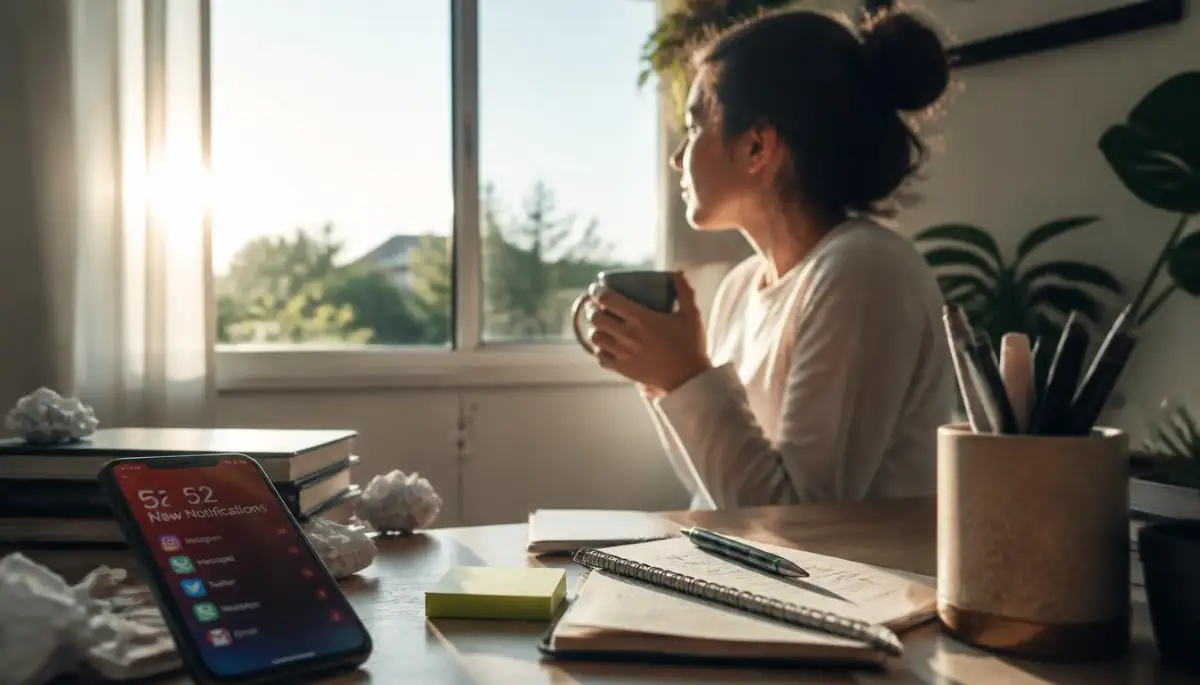
I started by moving every single non-essential app into a folder on the last page of my phone screen. Then, I turned off all notifications except for phone calls and direct text messages. No social media pings, no news alerts, and definitely no "shopping deal" emails.
I felt a strange sense of panic for the first few hours. My thumb kept moving toward where the Instagram icon used to be. It was a muscle memory thing. It showed me just how addicted I had become.
Instead of scrolling during my lunch break, I sat by the window and just ate. It felt awkward at first. But then, I started noticing things. I noticed the way the light hit the trees outside. I actually tasted my food. My mind started to slow down, and for the first time in months, it didn't feel like a race.
Day 2: Reclaiming Your Creative Space
Once the initial "itch" to check your phone goes down, Day 2 is about filling the void. If you just take away the technology and don't replace it with anything, you will fail. Your brain will get bored and demand its digital drug.
On the second day, I focused on "analog" activities. I bought a physical notebook and a pen. When I had an idea, I wrote it down by hand. Writing by hand feels different. It is slower, more intentional, and it helps you process your thoughts better than typing on a screen.

I also spent two hours in the afternoon without any devices in the room. I worked on a project that required deep thought. Without the constant interruptions, I finished in two hours what usually takes me five. The flow state is real, but you can only find it when you kill the distractions.
Pro Tip: I found that keeping my phone in a completely different room helped more than anything else. If I have to walk 20 feet to check a text, I usually decide it isn't worth it. My laziness actually helped me stay focused!
Why Video Content Can Sometimes Make It Worse
Sometimes, we think we are relaxing by watching "helpful" videos, but even that can be a trap. If we watch too many things at once, our brain can't keep up. We need to be very picky about what we let into our minds.
If you want to see how much of a difference a few small changes can make, watch this short guide on how our brains react to constant digital noise.
Day 3: Building a Sustainable Future
The final day of the challenge is not about staying "off" the grid. It is about re-entering the digital world on your own terms. You cannot live in a cave, but you can choose how you use your tools.
On Day 3, I looked at my phone and asked, "Which of these apps actually adds value to my life?" I deleted about fifteen apps that I only used because I was bored. I realized that I didn't need a news app that sent me "breaking news" every ten minutes. If something is truly important, I will hear about it.
I also set up "Digital-Free Zones" in my home. The bedroom is now a phone-free zone. The dinner table is a phone-free zone. By creating these boundaries, I protected my mental space.
The clarity I felt by Sunday night was incredible. I felt lighter. I slept better than I had in years. I realized that I don't have to be "available" to the whole world at all times. My time and my attention are the most valuable things I own.
The Myth of Being "Productive" on Social Media
Many of us tell ourselves we are on social media for "networking" or "learning." While that can be true, 90% of the time it is just disguised procrastination. We scroll through other people's successes instead of working on our own.
Digital minimalism forces you to face your own life. When you stop looking at everyone else, you have to look at yourself. This can be scary at first. But it is also where true growth happens. You start to remember your own dreams and goals.
Practical Tips You Can Use Today
You don't have to wait for a weekend to start. You can take small steps right now to start clearing the fog. Here are a few things that worked for me:
- The Gray Scale Hack: Turn your phone screen to black and white. It makes the icons look boring, and you will find yourself wanting to look at them less.
- The Morning Rule: Do not touch your phone for the first 30 minutes of the day. Use that time to breathe, stretch, or drink water.
- The Notification Purge: Go into your settings and turn off 90% of your notifications. If it isn't a human trying to talk to you, you probably don't need to see it instantly.
- Physical Clocks: Buy a real alarm clock. This stops you from using your phone as an alarm, which usually leads to "one quick scroll" before bed.
How Mental Clarity Changes Your Relationships
One thing I didn't expect was how much this challenge helped my relationships. When I wasn't constantly looking at my screen, I was actually present with the people I love. I listened better. I noticed the small details in their faces and voices.
People can tell when you are only half-listening. When you give someone your full attention, it is a gift. it is about respecting the people around you.
Dealing With the Fear of Missing Out (FOMO)
The biggest hurdle for most people is the fear that they will miss something "important." I felt this too. What if a friend posts a big update? What if there is a sale?
Here is the truth: You will miss things. And that is okay. The world will keep spinning. The trade-off is that while you are "missing" a random update from a stranger, you are gaining your own life back. You are gaining the ability to think clearly, to create, and to be at peace.
Simple Summary of the 3-Day Plan
- Day 1: Physical separation and notification lockdown. Focus on the "Reset."
- Day 2: Analog immersion. Use paper, pens, and your own hands. Focus on the "Flow."
- Day 3: Intentional re-entry. Delete the trash and set permanent boundaries. Focus on the "Future."
Finding Peace in a Noisy World
Regaining your mental clarity is not a one-time event. It is a practice. My three-day challenge was a "jumpstart," but the habits have stayed with me. I still have days where I scroll too much, but now I know how to get back to the surface.
I feel like I have my brain back. I can read a book for an hour without feeling restless. I can sit in a park and just enjoy the sun. These things sound simple, but in our modern world, they are superpowers.
If you feel overwhelmed, I highly suggest you try this. You don't need any special tools. You just need the willingness to put the phone down and look at the world around you. Your mind will thank you for it.
Your Path Forward
Don't overthink this. You don't need a perfect plan. Just start by turning off your notifications tonight. See how it feels to wake up tomorrow without a digital to-do list staring you in the face.
You deserve to have a clear mind. You deserve to feel focused and calm. The digital world will always be there, but your time is limited. Spend it on things that truly matter.
Take the challenge. Three days is all it takes to start seeing the light again. I did it, and I know you can do it too. Let's reclaim our focus together.
Protecting Your Focus for the Long Haul
After finishing the initial three-day challenge, the real work begins. You don't want to fall back into the same old trap of mindless scrolling. I found that the best way to stay sharp is to treat my attention like a bank account. If you spend it all on junk content, you have nothing left for the things that matter.
One secret I learned from top focus experts is the concept of a "Digital Sabbath." This means picking one day a week where you go completely offline. For me, this is usually Sunday. I put my phone in a kitchen drawer on Saturday night and don't touch it until Monday morning. The silence is scary at first, but it is also where your best ideas come from.
I also started practicing "Batching." Instead of checking my email or messages every time a red bubble appears, I do it twice a day. This keeps my brain from jumping between tasks. You can learn more about how this helps your eyes and brain by checking out these easy screen adjustments that work right now. It makes a huge difference in how tired you feel at the end of the day.
Another advanced trick is to change your phone's physical environment. I bought a small "phone jail" with a timer. If I know I need to write or work for two hours, I lock my phone inside. Since I cannot physically get to it, my brain stops craving it. It is a simple way to use your own psychology against the apps designed to addict you.
Why Your Brain Craves the Slot Machine Effect
We have to understand that apps are built like slot machines. Every time you pull down to refresh your feed, you are looking for a "win." Maybe it is a like, a funny video, or an interesting news story. This releases dopamine in your brain. Over time, your brain becomes lazy. It would rather have the easy dopamine from a screen than the hard-earned dopamine from finishing a big project.
To fight this, I started rewarding myself with real-life experiences. If I stay off my phone all morning, I treat myself to a walk in the park or a favorite cup of coffee. I am retraining my brain to enjoy the real world again. This is very similar to how students manage high-pressure situations, which you can see in these real recovery strategies for burnout.
According to research from the National Center for Biotechnology Information, excessive screen time is linked to lower emotional stability. This is why you feel grumpy after spending two hours on TikTok. Your brain is literally overstimulated. By stepping back, you allow your nervous system to return to a calm state.

The Trap of Replacing One Screen With Another
One of the biggest mistakes I made early on was putting down my phone just to pick up a tablet or turn on the TV. I thought I was "detoxing," but I was just changing the delivery method. Your brain doesn't care if the screen is 6 inches or 60 inches. It is still being bombarded with blue light and fast-moving images.
If you spend your phone-free time watching a three-hour movie, you aren't giving your mind a break. It is about sitting with your own thoughts without needing a distraction. If you find yourself reaching for the remote as soon as you put down your phone, stop and ask yourself why.
Are you bored? Are you lonely? Are you anxious? Most of the time, we use screens to hide from these feelings. But when we hide, we never grow. I realized that my screen addiction was a way to avoid my own stress. Dealing with that stress directly was the only way to find true peace.
Forgetting to Tell Your Inner Circle
Another mistake is trying to do this in total secret. If your boss or your partner expects an instant reply, they will get frustrated when you don't answer. This creates new stress that can ruin your progress. You have to set expectations.
I told my family and my close friends, "I am doing a digital reset. If it is an emergency, call me. Otherwise, I will get back to you in the evening." Most people actually respected this. Some even said they wished they had the courage to do the same!
Communication is a skill that gets rusty when we only use emojis. If you want to improve your real-life connections, you might find these active listening hacks very helpful. They help you fill the space that social media used to occupy with meaningful conversations.
The Danger of the "All or Nothing" Mindset
Some people think that if they check their phone once during the challenge, they have failed and should just give up. This is a dangerous way to think. Progress is not a straight line. If you slip up and scroll for ten minutes, don't throw away the whole day.
Just acknowledge it and put the phone back down. The goal isn't to be perfect; the goal is to be better than you were yesterday. I used to beat myself up over every small mistake. This just made me more stressed, which made me want to use my phone more! It was a nasty cycle.
I learned to be kind to myself. If I had a bad day, I just started over the next morning. This is the same advice doctors give to people who are spotting the subtle signs of prediabetes. You don't give up on your health because of one bad meal. You just make a better choice next time.
Staying Mindful in a World That Wants Your Data
The digital world is not going away. In fact, it is getting smarter. Algorithms are being designed to know exactly what makes you click. This is why you must stay guarded. If you aren't paying for the product, you are the product. Your attention is being sold to the highest bidder.
I started looking at my phone as a tool, like a hammer. You use a hammer to drive a nail, and then you put it away. You don't walk around carrying the hammer all day, looking at it every two minutes. Treat your phone the same way. Use it for a specific task, and then put it back in its place.
According to a study by the American Psychological Association, constant checkers are significantly more stressed than those who don't check their devices regularly. This stress affects your body physically. For example, sitting for long hours while scrolling can harm your circulation. You can read more about how sitting affects your veins to understand the physical cost of our digital habits.
Your New Action Plan for a Clear Mind
Now that you have the tools, it is time to move forward. Don't let this be just another article you read and forget. Start by choosing your "Digital Sabbath" day. Mark it on your calendar with a big red circle. This is your day to be human again.
Next, identify your "Trigger Apps." We all have them. For some, it is Instagram. For others, it is the news or a mobile game. Delete them for just one week. I promise they will still be there if you decide to go back. But I think you will find that you don't miss them as much as you thought you would.
My Personal "Emergency" Phone Settings
Since I can't stay offline 24/7 for work, I set up these "safeguards" on my phone:
- The Grayscale Mode: I turned my screen black and white. It makes Instagram look like a boring newspaper, so I stop scrolling faster.
- Charging Station: My phone stays in the kitchen at night. If I want to check it, I have to stand up and walk—which usually stops me from mindless late-night browsing.
Finally, find a hobby that uses your hands. Whether it is cooking, gardening, or building models, doing something physical grounds you in reality. It provides a type of satisfaction that a "like" button can never match. Real life is high-definition; don't spend it looking at a low-res version on a screen.
I want you to imagine how you will feel a month from now if you stick to these habits. Imagine waking up with a clear head. Imagine being able to focus on a book for hours. Imagine feeling calm even when the world is chaotic. This is possible for you. I have seen it in my own life, and I know it can happen for you too.
The path to mental clarity is not about adding more things to your life. It is about taking away the noise so you can hear your own heart. Your brain is a beautiful machine; stop clogging it with digital trash. Take that first step today, even if it is just turning off your phone for an hour.
I used to be a slave to every ping and buzz from my pocket. I felt tired, anxious, and lost in a fog. But since I embraced digital minimalism, I feel like I finally have the keys to my own mind. My focus is back, my stress is down, and I am actually living my life instead of just watching it. I want that same freedom for you, and it all starts with a simple choice to put the screen down.
Common Questions About Digital Minimalism
What if my job requires me to be on social media or my phone?
You can still practice digital minimalism by setting strict work hours. Use a separate device for work if possible, or use desktop versions of apps to avoid the addictive "scroll" features on mobile. When the workday is over, log out completely and put the device away.
Will I lose my friends if I don't reply instantly?
True friends will understand and likely admire your boundary. Most "instant" messages are not urgent. By waiting to reply, you actually show people that you value your time and theirs, leading to more meaningful conversations later on.
Is digital minimalism the same as quitting the internet?
Not at all. It is about using the internet as a tool rather than letting it use you. It means being intentional about which apps you use and for how long, so you can spend more time on the things that actually make you happy.
How do I deal with the boredom during a detox?
Boredom is actually a sign that your brain is healing. Instead of running away from it, sit with it for a few minutes. You will find that boredom often leads to creativity and new ideas that you never would have had while staring at a screen.
Can kids and teenagers do this challenge too?
Yes, and it is very helpful for them. Since their brains are still developing, they are even more sensitive to digital distractions. Doing the challenge together as a family can be a great way to bond and set healthy habits for the future.
Disclaimer: This content is for informational purposes only and does not substitute for professional medical or psychological advice. If you are struggling with severe anxiety, depression, or technology addiction, please consult with a qualified healthcare professional. We prioritize your well-being and encourage a balanced approach to mental health.