
The Secret Battle with Medical Latin and Endless Diagrams
I remember sitting at my small desk at two in the morning, staring blankly at a complex diagram of the human skull. Tears of pure frustration blurred my vision as I tried to force twenty different bone names into my exhausted brain. It felt like trying to read a foreign language without a dictionary, and my first major anatomy exam was only forty-eight hours away.
My heart was racing, my head was throbbing, and I felt like a complete failure. I had spent hours highlighting pages in neon green, yet I could not remember the difference between the sphenoid and ethmoid bones. That night, I realized that my old ways of studying were simply not going to cut it anymore.
Many students face this exact nightmare every single week in their academic lives. The sheer volume of Greek and Latin terms can make you feel completely helpless and overwhelmed. This intense academic pressure often steals your sleep, ruins your weekends, and leaves you doubting your own intelligence.
It is not just about getting bad grades on paper. It is about the constant anxiety that eats away at your mental peace and makes you dread opening your textbooks. You feel like you are working twice as hard as everyone else but getting only half the results.
The main issue is that we are taught to memorize things by repeating them over and over. This old-school rote learning method is incredibly boring and highly inefficient for your brain. It is like trying to write on water; the information disappears almost as soon as you look away.
To help you understand why your current study habits might be holding you back, let us look at how traditional study methods stack up against modern, science-backed techniques.
How to Rewire Your Brain for Rapid Anatomy Learning
To stop the endless cycle of forgetting, you must change how you feed information to your brain. Your brain is not a computer hard drive; it is an organic network that thrives on patterns, stories, and associations.
By using targeted cognitive strategies, you can turn dry medical terms into vivid memories that stick around for the long haul. Let us explore the most effective, science-backed ways to master your anatomy exams without losing your mind.
Build a Memory Palace in Your Own House
The Method of Loci, commonly known as the Memory Palace, is one of the oldest and most powerful memory tools in human history. This technique works by attaching new information to physical places that you already know like the back of your hand.
To start, picture your childhood home or your current apartment in your mind. Walk through the front door, move into the kitchen, and then step into the living room. Each of these physical spaces will act as a digital storage folder for a specific anatomical term.
For example, if you need to memorize the cranial nerves in order, place a giant, smelly bottle of perfume right at your front door to represent the Olfactory nerve (which controls smell). Next, place a pair of giant, glowing sunglasses on your kitchen counter to remind you of the Optic nerve.
This works because your brain is naturally wired to remember physical spaces much better than abstract words on a page. By placing funny, strange, or dramatic objects along your mental path, you make the terms impossible to forget.
Decode the Secret Language of Latin Roots
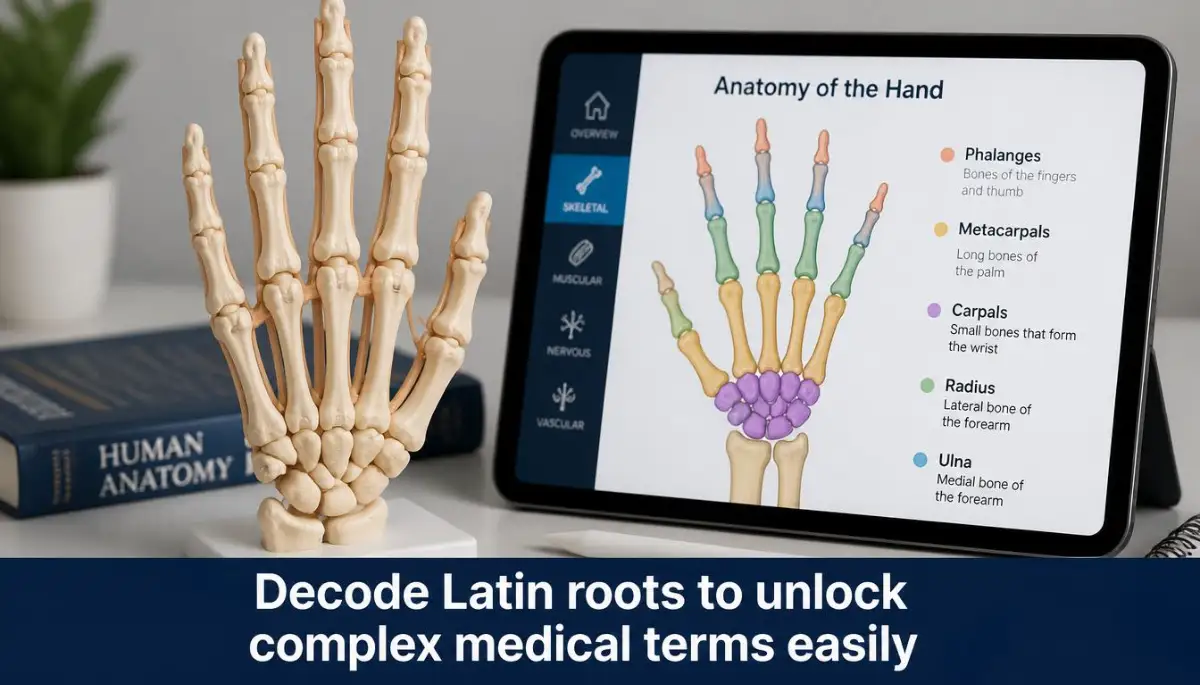
Anatomy terms can look like a jumbled mess of letters, but they are actually just Lego blocks of Latin and Greek words. Once you learn to decode these simple building blocks, you can understand almost any medical term instantly.
For instance, whenever you see the prefix "chondro-", your brain should immediately think of cartilage. When you see "osteo-", you know the topic is about bones, and "myo-" always refers to muscles.
Let us look at the word "osteoarthritis" as a simple example. By breaking it down, you get "osteo" (bone), "arthr" (joint), and "itis" (inflammation). Suddenly, a scary-sounding nine-letter word simply means "inflammation of the bone and joint."
Instead of memorizing thousands of individual words, focus your energy on learning the fifty most common medical prefixes and suffixes. This simple shift will save you hundreds of hours of study time and make your textbooks feel much easier to read.
Use Spaced Repetition to Fight the Forgetting Curve
Your brain is designed to discard information that it thinks you do not need anymore. According to cognitive science, we forget more than half of what we learn within twenty-four hours unless we actively review it.
The secret to beating this system is spaced repetition, which means reviewing the material right before your brain is about to forget it. Instead of studying the heart anatomy for five hours in one night, study it for thirty minutes on five separate days.
You can use free digital flashcard apps like Anki to automate this schedule for you. The app will show you difficult cards more often and easy cards less often, keeping your brain active. This constant challenge forces your brain to build stronger neural pathways. It turns temporary short-term memories into solid, permanent knowledge that you can recall easily during a stressful exam.
Do you want to see exactly how medical students use these memory tricks to ace their exams? Watch this brief guide to see the visual step-by-step breakdown of how these brain hacks work in real time.
Create Ridiculous and Memorable Mnemonics
Acronyms and silly sentences are incredible tools for keeping lists of anatomical structures in the correct order. The weirder and more unusual the sentence is, the easier it will be for your brain to remember it.
To memorize the eight carpal bones of the wrist (Scaphoid, Lunate, Triquetrum, Pisiform, Trapezium, Trapezoid, Capitate, Hamate), students often use a simple phrase. A popular one is: "She Looks Too Pretty; Try To Catch Her."
Each starting letter in that goofy sentence matches the first letter of a carpal bone. When you are sitting in the exam hall and panic starts to creep in, this simple phrase acts as a safety net.
You can make your own custom phrases using names of friends, favorite foods, or funny situations. The key is to make them personal, highly visual, and amusing.
Apply the Feynman Technique by Teaching a Toy
One of the best ways to test if you truly understand an anatomical system is to try and explain it in simple terms. If you cannot explain a concept to a ten-year-old child, you do not fully understand it yet.
Grab a stuffed animal, a pet, or even an imaginary friend and explain how blood flows through the chambers of the heart. Do not use complex medical words; use everyday analogies instead.
For example, compare the atrium to an entrance lobby and the ventricle to a powerful water pump. This simple exercise will quickly highlight the gaps in your own understanding.
Once you identify where you got stuck or confused, open your textbook and review that specific section again. This active feedback loop is highly effective for deep learning.
Draw and Label Your Own Diagrams from Memory
Looking at colorful, professionally printed diagrams in a textbook gives you a false sense of security. You might think you know the diagram, but your brain is actually just recognizing the colors and shapes.
To build real memory strength, close your book, grab a blank sheet of paper, and try to draw the structure yourself. It does not need to look like a beautiful piece of art; simple circles, lines, and boxes are perfectly fine.
As you draw, label each part of the structure out loud and explain its main function. If you get stuck on a certain part, do not look at your book immediately. Try your absolute best to recall it first.
This active struggle is where the real learning happens. Once you are finished, compare your drawing to the textbook to see what you missed.
My Personal realization: I used to spend hours highlighting my textbooks with bright yellow markers, thinking I was studying hard. My pages looked beautiful, but I kept failing my practice quizzes because highlighting is a passive activity. I finally realized that my brain only remembers things when I force it to work hard and produce answers from scratch.
Group Muscles and Bones by Their Real-Life Function
Instead of trying to memorize muscles as a massive, endless list, group them together by what they actually do in the body. Your body is a highly logical machine, and its parts work together in functional teams.
For example, group the muscles that help you bend your elbow together, and then group the muscles that help you straighten it. This creates a logical mental map of cause and effect.
Act out the movements with your own body as you study them. Touch your own arm, feel the muscle tighten, and say the name of the muscle out loud.
Connecting physical touch and movement to a written term creates multiple memory pathways in your brain. This makes the information far easier to access when you are sitting still during an exam.
Take Regular Strategic Breaks to Help Your Brain Rest
Your brain needs physical downtime to organize and store the new information you have gathered. If you study for three hours straight without a single break, your brain will stop absorbing new facts.
Use the Pomodoro Technique to keep your mind fresh and alert. Study with absolute focus for twenty-five minutes, and then take a complete five-minute break to stretch, drink water, or walk around.
During these short breaks, do not check your smartphone or look at social media. Your brain needs real rest, not more digital screens and distractions.
After completing four study sessions, take a longer break of thirty minutes to fully recharge. This simple routine prevents brain fatigue and keeps your focus levels incredibly high.
Unlocking Master-Level Cognitive Tools for Lifetime Retention
Once you understand the basics of spatial memory and decoding roots, you can start using advanced strategies that top medical students use. These methods do not require you to study longer hours. Instead, they change how your brain processes and stores complex sensory data so you can retain it forever.
Somatic Encoding: Using Your Body as a Living Map
Your body is the ultimate, three-dimensional study guide for human biology. Somatic encoding is the practice of physically touching or moving your own muscles and joints while saying their anatomical names out loud. When you study the bones of the arm, do not just stare at a flat screen or a paper book.
Touch your own wrist, find the specific bony bumps, and feel how they move when you twist your hand. By physically connecting the printed medical terms to your own flesh and bones, you create a deep physical memory. This turns abstract terms into real, hands-on experiences that your brain can easily retrieve during a stressful exam.
To make this even more effective, you can practice active listening habits with a study partner. Take turns explaining different muscle movements while physically pointing to them on each other. This physical interaction adds a social and sensory layer to your study sessions, making it much harder to forget the details.
Sleep-Dependent Memory Consolidation
Many students do not realize that your brain does not actually store permanent memories while you are awake. Real memory storage happens when you are asleep, during a biological process called memory consolidation. According to cognitive studies published on National Institutes of Health research databases, your brain replays your daytime study sessions while you sleep to convert them into long-term knowledge.
If you cut your sleep short to study for two more hours, you are actually stopping your brain from storing the things you just learned. To use this natural system to your advantage, review your most difficult anatomy flashcards right before you go to sleep. Do not look at social media or check your text messages after this final study session.
Let your brain drift directly into sleep with those anatomical terms fresh in your working memory. This simple habit allows your brain to process the difficult terms all night, making them much easier to recall the next morning.
Auditory Association and Sensory Cues
Your brain is incredibly sensitive to sounds, smells, and colors when it is trying to record new information. You can use this natural sensitivity to create strong sensory anchors for different anatomical systems. For example, play a specific instrumental music track only when you are studying the nervous system.
You can also use a specific scent, like peppermint or lemon oil, in your study room only when reviewing complex muscle groups. When you enter the exam room, your brain will automatically recall the scent or the music, which helps you retrieve the associated anatomical terms. This simple sensory trick builds an invisible bridge between your quiet study room and the busy exam hall.
Just like managing your limited time is a key part of dealing with college burnout, setting up these quiet sensory study routines keeps your mind calm. It prevents your brain from getting overwhelmed by too many mixed signals.
Building Your Action Plan for Long-Term Success
To keep these memories fresh for months or even years, you need a simple, consistent routine. You cannot rely on last-minute studying if you want to be a successful healthcare professional in the future. Instead, think of your brain like a physical muscle that needs regular, gentle exercise to stay strong and healthy.
- Review your active recall cards for just fifteen minutes every morning while having your breakfast.
- Spend five minutes at night drawing a quick, rough sketch of a complex organ from memory.
- Teach one anatomical pathway to a classmate or a family member at the end of each study week.
- Take a short walk and try to name the bones in your feet with every single step you take.
By making these simple habits a natural part of your daily life, you remove the fear from anatomy. You will find that you do not need to cram anymore because the terms are already deeply wired into your long-term memory.

Hidden Study Traps That Drain Your Brain Power
When students are desperate to pass a difficult exam, they often fall into common study traps that actually damage their learning progress. These mistakes feel like hard work, but they are highly inefficient and often lead to extreme mental exhaustion. Understanding these traps is the first step toward protecting your mental health and saving your study time.
The Illusion of Competence Through Passive Review
The biggest mistake students make is confusing recognition with actual recall. When you read over your highlighted notes three or four times, the text starts to look very familiar to your eyes. Your brain whispers that you know the material, but this is a dangerous mental trap.
There is a massive difference between recognizing a term when you see it on a page and pulling that term out of your head on a blank exam sheet. Passive reviewing does not challenge your brain, so it does not build strong, lasting neural connections. To check if your studying is actually working, read the findings on active retrieval practice in Nature science journals.
If you are not actively testing yourself and making mistakes during your study sessions, you are simply wasting your time. You will likely experience a sudden brain freeze as soon as you look at a blank exam paper.
Wasting Hours on Elaborate, Clean Notes
Another common trap is spending too much time making beautiful, color-coded study guides instead of actually learning the material. Students often spend hours drawing perfect anatomical illustrations, using ten different colored pens, and copying definitions word-for-word. This feels highly productive, but it is actually just a creative way to avoid the hard mental work of active testing.
Your notes do not need to look like a professional art project to be helpful to your brain. In fact, rough, messy sketches that you draw from memory are ten times more effective for your learning than neat, traced diagrams. Focus your limited energy on active recall rather than spending all day organizing paper or adjusting digital fonts on your tablet.
If you are using modern digital study aids to help you learn, make sure they are testing your knowledge, not just showing you pretty pictures. The goal of studying is to build strong memories in your mind, not to create a collection of beautiful notebooks.
The Cognitive Dangers of High-Stress Cramming
Many students think they can survive tough anatomy courses by staying up all night before the exam to cram. While this might help you pass a simple quiz, it completely destroys your long-term memory and ruins your physical health. When you cram under high stress, your body releases a hormone called cortisol, which actually blocks your brain from accessing stored information.
This is why many students experience sudden panic and memory blockages during exams, even though they studied all night. Furthermore, the information you cram is quickly forgotten within forty-eight hours after the test is over. This creates a terrible cycle where you have to relearn everything from scratch for your final exams, leading to massive academic stress.
To avoid this constant cycle of panic, you must treat your study time like a valuable resource. Much like budgeting your limited time when resources are tight, you must distribute your study sessions evenly over several weeks.
Relying Too Much on Screen Time and Digital Distractions
In our digital age, it is easy to get lost in a sea of study apps, educational videos, and online anatomy models. While these tools can be highly useful, staring at a bright screen for six hours straight can cause severe digital eye strain and mental fatigue. Even worse, notifications from social media or text messages constantly break your deep focus and disrupt your learning flow.
Every time you stop studying to check a notification, your brain takes up to twenty minutes to get back into a state of deep concentration. To protect your brain power, try turning off your phone or controlling digital distractions entirely during your core study blocks.
Use physical books, paper flashcards, and real anatomical models whenever you can to give your eyes a necessary break. This offline study approach keeps your mind calm, reduces stress, and helps you focus deeply on the complex structures you need to learn.
Your Roadmap to Stress-Free Anatomy Mastery
To sum up, mastering human anatomy is not about having a special, photographic memory. It is simply about using the right learning systems that match how the human brain naturally processes and stores new information. By moving away from boring rote learning and embracing active recall, spaced repetition, and physical encoding, you can learn medical terms with confidence.
Your Action Steps for Tomorrow Morning
To make these changes real, do not try to change your entire study routine overnight. Instead, pick just one simple technique from this guide and try it out during your next study session.
- Find five common Latin roots in your next chapter and write down what they mean.
- Create one funny, memorable phrase to remember a difficult list of bones or muscles.
- Draw a simple, messy diagram of an organ from memory on a scrap piece of paper.
- Go to bed thirty minutes earlier tonight to let your brain consolidate what you learned today.
These small, consistent changes will quickly add up to massive results over the course of your academic journey. You will soon realize that you are remembering difficult terms much faster, scoring higher on quizzes, and enjoying your free time without feeling constant guilt.
I know how scary it feels when you are staring at an anatomy book, but my personal study journey proved that your brain can learn anything when you change your system. Trust these methods, take a deep breath, and start small today. You have the power to master this subject, and your future patients will thank you for the hard work you are doing right now.
Frequently Asked Questions About Memorizing Anatomy
Why is human anatomy so hard to remember?
Anatomy is difficult because it involves learning a completely new language made of Greek and Latin terms. Traditional study methods like highlighting or reading textbooks repeatedly do not work well because they do not force your brain to actively process or apply the information.
Can I learn anatomy without memorizing everything by heart?
Yes, you should focus on understanding the logic of the body instead of raw memorization. By learning common Latin prefixes and grouping structures by their physical functions, you can naturally predict and understand the names of most muscles, bones, and pathways.
How many hours a day should I spend studying anatomy?
Instead of studying for hours at a time, aim for short, focused sessions of forty-five to sixty minutes spread throughout the day. Using spaced repetition and regular active testing is much more effective than sitting at your desk for six hours straight.
Is drawing better than looking at pre-made anatomical flashcards?
Drawing your own rough diagrams from memory is much better because it forces your brain to actively retrieve the shapes and labels. Pre-made cards are helpful for quick reviews, but the physical act of drawing creates much stronger and more durable memory pathways.
Disclaimer: The information provided in this article is for educational and informational purposes only and should not be taken as professional medical advice, diagnosis, or treatment. Always consult with a qualified healthcare professional or academic advisor regarding your specific studies or health-related questions.