
The Quiet Panic of Watching Your Dream Project Crumble
I know that sick feeling in your stomach when you realize your business isn't working. You’ve spent your savings, skipped sleep, and told everyone this was 'the one,' but the sales just aren't happening. I’ve been there, staring at a laptop screen at 2 AM, wondering if I should just quit and get a regular job. If you feel like your dream is falling apart, stop. You don't need a miracle; you need a pivot. Let’s talk about how to turn things around before the money runs out.
But the market did not care about my spreadsheet. Within weeks of launching, nobody was buying, my savings were draining, and I felt like a total failure. I did not want to admit that my dream was falling apart.
This is a quiet panic that many new business owners face every day. You pour your heart, time, and money into an idea, but the results just do not show up. You check your bank account every morning with a heavy feeling in your chest.
You find yourself staring at the ceiling at 3:00 AM, wondering where you made a mistake. The stress begins to affect your relationships and your health. It is not just about losing money; it is about losing your confidence.

If you are in this position right now, I want you to take a deep breath. You are not alone, and this is not the end of your journey. Many of the biggest companies we know today started with a plan that failed completely.
The secret to their survival was not a perfect start. It was their ability to change direction when they realized they were wrong.

How to Tell When Your Startup Needs a New Direction
To fix a failing business, you must first be completely honest with yourself. It is easy to ignore the warning signs because you love your original idea.
🛑 The "Startup Survival" Cheat Sheet
If you are too busy to read the whole post, here are the 4 things you need to do right now:
- Stop the Bleeding: Cancel every software subscription and ad campaign that isn't making you money TODAY.
- Forget Your Ego: Your original idea might be wrong, and that’s okay. The market is the only boss you should listen to.
- Talk to 10 People: Don't guess. Call 10 people who didn't buy from you and ask them "Why?" without getting defensive.
- Simplify Everything: If your product has 5 features, pick the best one and delete the other 4. Focus is your superpower.
However, ignoring the data will only lead to a faster collapse. Let us look at how you can spot the real signs of trouble.
Look at Your Customer Action Rates
Are people actually buying your product, or are they just telling you it is a nice idea? There is a big difference between polite praise and real sales.
If you have a lot of website visitors but zero sales, your current offer is not working. Your target audience is trying to tell you something, and you need to listen.
If people buy your product once but never come back, you have a retention problem. A healthy business relies on repeat customers.
When people walk away after one experience, it means your product is not solving their actual problem.
Track Your Marketing Spend Against Your Sales
Are you spending fifty dollars on ads just to make a ten-dollar sale? This is a quick way to run out of money.
If your customer acquisition cost is way higher than what they spend, your model is broken. You cannot scale a business that loses money on every single transaction.
Sometimes, you might think you just need more ads. But more ads on a broken product will only lose you more money.
Pay Attention to Your Own Energy Levels
Are you still excited to work on your business, or do you feel a sense of dread? When a plan is not working, it drains your mental battery.
If you find yourself avoiding your daily tasks, it is a sign of burnout. A business cannot survive if the founder has no energy left to drive it.
Your energy is your most valuable resource. When it starts to fade, you must take a step back and change your approach.
Actionable Steps to Save Your Startup
Once you accept that your plan is not working, you need a clear path forward. This is where a pivot strategy comes in.
A pivot is not a failure; it is an intentional change in your business model. Here are the practical steps you can take today.
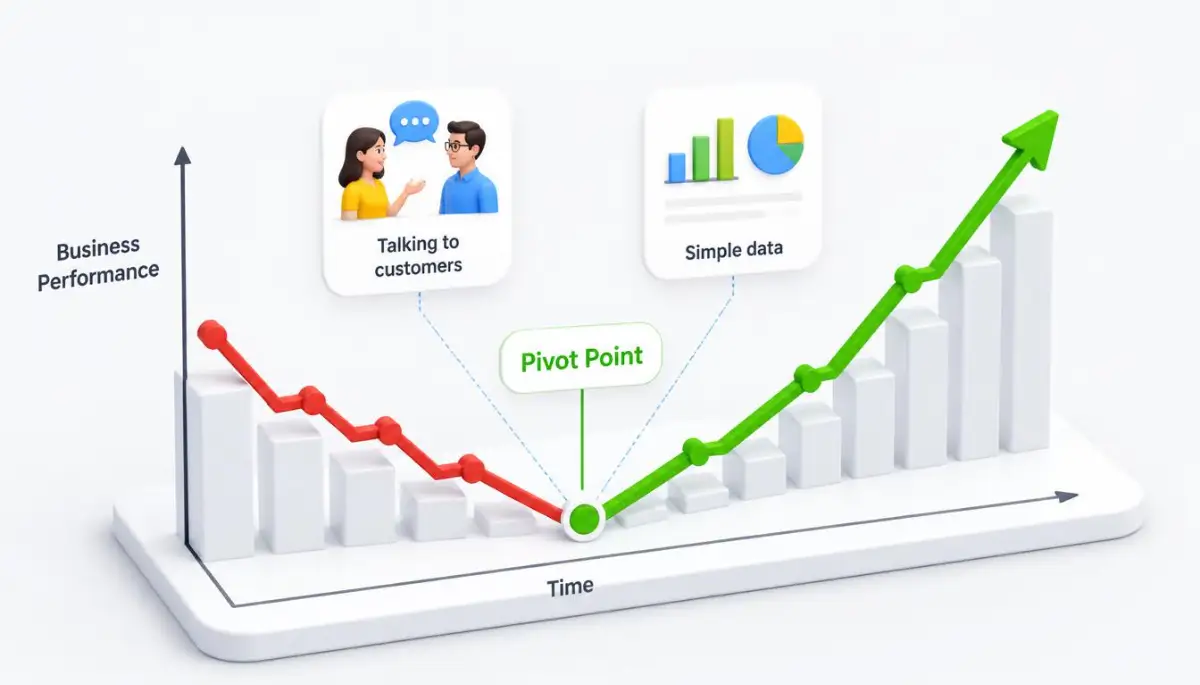
Talk to the Customers Who Walked Away
Stop looking at your dashboard and start talking to real people. Reach out to the users who signed up but never bought anything.
Ask them simple, open-ended questions about their experience. The goal is to find out what they were actually looking for.
Do not try to sell them anything during these chats. Just listen to their frustrations and their needs.
You might find that they have a problem that your business can solve in a completely different way.
Strip Your Product Down to the Basics
When a business plan fails, it is often because the product is too complicated. You might have added too many features that nobody actually wants.
Take a look at your offer and find the one thing that actually brings value. Cut out everything else and focus only on that single feature.
This is often called a Minimum Viable Product (MVP). It allows you to test your new direction without spending a fortune.
Want to see how major companies shifted their plans and found wild success? Check out this short breakdown of famous business pivots.
Focus on a Smaller, Specific Group of People
Maybe your product is great, but you are trying to sell it to everyone. When you try to speak to everyone, you end up speaking to no one.
Find a small group of people who have the most urgent need for your product. Focus all your marketing and message on this specific group.
Once you win over this small group, you can slowly expand your reach to other areas.
My Personal Realization:
I once kept a software feature that customers hated for six months because I loved it. I had to let go of my ego to save the company. Keep your ears open and your pride low.
Different Ways to Pivot Your Business
A pivot does not always mean changing your entire product. Sometimes, a small shift in another area can make a massive difference.
Let us look at a quick comparison of the most common types of pivots.
The Value Pivot: Changing How You Help
Sometimes, your customers like your product, but they use it for a reason you did not expect. This is a huge clue for a value pivot.
Look at what your active users are doing. If they are using a secondary feature more than the main one, make that secondary feature your new main offer.
This is exactly how companies like Slack and Instagram became successful. They started as completely different platforms and pivoted to focus on what users loved most.
The Audience Pivot: Finding the Right Buyer
You might have a great product but the wrong audience. For example, you might be trying to sell to big companies when small freelancers need you more.
Shift your messaging to target the group that shows the most excitement. A change in your target audience can instantly make your marketing more effective.
Pivot Myths vs. Reality (What I Actually Learned)
Do not be afraid to walk away from a market that is not buying. Go where the demand is highest.
How to Protect Your Remaining Cash and Energy
When you are pivoting, you do not have the luxury of time or unlimited money. You must treat your remaining resources with extreme care.
Stop All Unnecessary Spending Immediately
Go through your business bank statements and cancel every subscription you do not need. Cut your marketing budget until you have validated your new direction.
Your only goal right now is to keep your business alive while you figure things out. Every dollar you save gives you another day to test your new pivot.
The "Keep or Kill" Checklist
Before you spend another cent on ads or development, ask yourself these three questions:
- The "Mom" Test: If I explain this to a stranger, do they say "That’s nice" (Politeness) or "How do I buy it?" (Interest).
- The 3-Month Rule: Can I survive another 90 days if I make zero sales? If the answer is no, you need to cut your costs by 50% by tonight.
- The Feature Trap: Is there one single part of my business that people actually like? If yes, kill everything else and sell only that.
Do not worry about fancy tools or branding. Focus only on survival.
Set a Strict Timeline for Your Pivot
Do not let your pivot drag on forever. Give yourself a clear deadline, like thirty or sixty days, to test the new model.
If you do not see positive signs by that date, you may need to adjust again. A deadline keeps you focused and prevents you from wasting more resources.
Without a timeline, you might fall into the same trap of hoping for a miracle.
Build a Small Support Network
Going through a business pivot is incredibly lonely. Find other business owners who have been through similar struggles.
Talk to a mentor or join a local startup community. Sharing your worries with people who understand can lift a huge weight off your shoulders.
You do not have to carry the entire burden alone. Asking for advice is a sign of strength, not weakness.
Keeping Your Team Aligned During a Shift
If you have employees or partners, a sudden change in direction can cause fear and confusion. You must manage this transition carefully to keep everyone motivated.
Be Completely Honest with Your Team
Do not try to hide the fact that the original plan is not working. Your team can usually tell when things are going wrong anyway.
Gather them together and explain the situation clearly. Explain why the change is necessary and how it will help the business survive.
When you are transparent, your team will trust you more and work harder to support the new path.
Give Everyone a Clear Role in the New Plan
During a pivot, people often feel unsure about their job security. Give each team member a specific task related to the new direction.
This keeps everyone busy and focused on positive action. When people have a clear goal, they spend less time worrying about the future.
Review their progress daily to make sure everyone is moving in the same direction.
The Power of Staying Flexible
In the end, the most successful entrepreneurs are not the ones who never fail. They are the ones who learn how to adapt when they do.
A business plan is just a guess made before you have real-world data. When that data arrives, you must be willing to let go of your old assumptions.
Treat your business like a series of scientific experiments. If one experiment fails, you do not stop being a scientist; you just design a new experiment.
Keep your head up, stay close to your customers, and do not be afraid to change your course. Your next pivot might be the very thing that leads you to success.
How to Guide Your Startup Through a Smart Transition
When you decide to shift your business direction, you enter a testing phase. This phase requires a different set of skills than your initial launch. You must move away from heavy planning and focus entirely on fast learning.
Many founders think that changing direction is a sign of weakness. In reality, it is the ultimate test of your business intelligence. The best entrepreneurs are not the ones who get it right first time, but those who learn the fastest.
To navigate this transition, you need to set up clean systems in your daily work. You cannot rely on guesswork anymore. Every move you make must be based on real data and close contact with your users.
Mastering the Art of the Lean Pivot: Pro Secrets for Long-Term Startup Survival
Developing an Agile Testing System
Instead of guessing what your customers want, you must create simple weekly experiments. A weekly experiment allows you to test one specific change at a time. This keeps your business flexible and prevents you from wasting precious capital.
For example, if you want to test a new service, do not build a complex website first. Instead, create a simple landing page and see if anyone signs up. This approach saves you months of work and keeps your mental energy high.
According to a research study on entrepreneurial survival from the National Bureau of Economic Research, startups that use structured testing systems are far more likely to survive than those that rely on pure instinct. You must make data your primary partner during this transition.
Managing the Capital Gap During the Shift
A major shift in your business model will always put a strain on your bank account. You must manage your personal and business expenses with extreme care. This is especially true if you are transitioning from a stable job or managing unpredictable sales.
To keep your business running, you need to understand how to handle irregular cash flow. You can use these smart budgeting methods for self-employed pros with unstable income to keep your head above water. These budget systems will protect your business from running out of cash during the middle of your pivot.
Additionally, do not overlook the tax savings that can keep more money in your pockets. If you work from home, look into smart tax deductions for home-based solopreneurs to reduce your overall expenses. Every dollar you save on taxes is a dollar you can use to test your new business model.
Building a Deep Listening Feedback Loop
To pivot successfully, you must master the way you talk to your community. This means you need to stop pitching your product and start asking deep questions. You must train yourself to hear the truth, even if it hurts your feelings.
Using tools like speak less connect more active listening hacks for professionals can completely change your relationship with your customers. When you listen deeply, you discover the silent frustrations your users are facing. These silent frustrations are where your next profitable business idea will come from.
To learn more about how to run these user interviews, you can study the design thinking resources from the Stanford d.school customer testing guidelines. They offer a clean framework for understanding what people actually want.
Using Modern Tech Without Losing the Human Connection
Many modern startups use automation tools to test new messages quickly. While automation is helpful, you must make sure your business does not start to sound like a cold machine. Your early customers want to buy from real people, not algorithms.
If you are using artificial intelligence to help you write copy or test ideas, make sure to read about beyond automation how creatives and ai work better together. This will help you keep your brand voice warm, friendly, and authentic. A warm brand voice builds trust, which is highly important when you are asking people to try a new service.

The Dangerous Traps That Destroy Pivoting Businesses
The Sunk Cost Fallacy and Holding On Too Long
The most common trap for founders is holding onto a failing idea because of the money they have already spent. They think that if they just spend a little more, the product will finally succeed. This is a dangerous mental trap that can ruin you financially.
This struggle is not unique to business owners. It is very similar to how ambitious students push themselves to the point of collapse. If you are feeling overwhelmed by this pressure, you might find comfort in these overcoming college burnout real recovery strategies for high-achievers. Both situations require you to let go of old plans to save your personal well-being.
When your business model is not working, the money you spent yesterday is gone forever. Your only job today is to make the best decision for the cash you have left.
Changing Direction Too Quickly on Single Opinions
On the other side of the coin, some founders change their business plan every time they get a single piece of negative feedback. This is called the "panic pivot." It confuses your team and makes your brand look highly unstable.
Before you make a major change, you must look for trends, not individual opinions. You need to gather feedback from at least ten to twenty active users before you decide to rewrite your plan.
A detailed study on entrepreneurial adaptation from Harvard Business School research on startup pivots shows that successful pivots are always based on clear market trends rather than quick reactions. Give your experiments enough time to produce real, reliable numbers.
Failing to Update Your Core Operations
It is easy to change the words on your website, but you must also change the way your business actually runs. If you pivot your product but keep your old sales process, your team will quickly get confused.
For example, if you shift from selling to individual customers to selling to large businesses, your entire schedule must change. Large businesses take months to make a decision, which means your cash flow timing will be completely different.
Make sure your daily calendar matches your new strategy. If you do not update your daily tasks, you will find yourself falling back into your old, comfortable habits.
Your Next Step Toward Building a Resilient Business
Navigating a business pivot is one of the hardest things an entrepreneur can do. It requires you to admit you were wrong, let go of your ego, and face the unknown. But this process is also where real business growth happens.
By stripping away the features that do not work and focusing on your customers, you build a much stronger foundation. Your new business will be based on real-world facts rather than hope and assumptions.
Remember to take care of your health and your mind during this stressful time. A business cannot run if its founder is completely exhausted. Keep your testing simple, keep your costs low, and stay close to your users.
I know how scary it feels to watch your original plan fall apart. But my own failures taught me that the best businesses are built on flexibility, not rigid rules. Start small, listen to your users today, and trust your ability to learn along the way.
Frequently Asked Questions About Business Pivots
How do I know if my business plan is actually failing or if I just need to wait longer?
If you have been active in the market for several months and your customer acquisition cost is consistently higher than your sales, your model is likely broken. A slow start is normal, but a complete lack of interest from your target audience means you need to adjust your offer. Do not wait until you run completely out of cash to make a change.
Can a small business pivot without spending a lot of money?
Yes, the best pivots are done on a very low budget. You should stop all paid advertising and focus on talking directly to your existing email list or social media followers. Create a simple, free prototype of your new service and ask people to try it before you build anything expensive.
What is the main difference between a pivot and starting a completely new business?
A pivot uses the strengths, assets, and customer relationships you have already built to shift in a more profitable direction. Starting a new business means throwing everything away and beginning from absolute zero. A smart pivot is always better because it saves your valuable momentum and experience.
How do I explain a business pivot to my existing customers?
Be completely honest and frame the change as an upgrade to their experience. Tell them that you have listened to their feedback and are making changes to serve them better. Most customers will appreciate your honesty and will feel excited to support your new direction.
Disclaimer: This article is for educational and informational purposes only. The strategies discussed here do not guarantee startup success or financial profit. Every business carries inherent risks, and founders should consult with professional financial and legal advisors before making major corporate decisions.