
Crypto Taxes Don't Have to Be a Nightmare: Here is How I Fixed My Messy Spreadsheet
Last April, I was staring at 15 different browser tabs, three exchange accounts, and a coffee that had gone cold hours ago. I’d made hundreds of trades—swaps, dips, and DeFi experiments—and now I had to explain all of it to the tax office. It felt like trying to solve a puzzle where the pieces kept changing shapes. If you’re feeling that same "tax season panic" right now, take a deep breath. I’ve been through the chaos, and I’m going to show you exactly how to simplify the process so you can file with total confidence.
I had made hundreds of trades over the past year, swapping tokens, buying dips, and trying out decentralized finance. To me, it felt like I was just having fun and building a small digital portfolio.
But as I opened a blank tax form, a cold wave of panic suddenly hit me. I had absolutely no idea how to turn my massive spreadsheet of trades into numbers the tax office would accept.
I felt completely lost, alone, and terrified of making a mistake that might trigger an audit. This isn't just my story.
Thousands of everyday crypto traders go through this exact mental torture every single tax season. We enter this space with dreams of financial freedom and exciting technology.
But nobody warns us about the mountain of paperwork waiting on the other side. Every single swap and even small purchases using a crypto card can count as a taxable event.
It feels like you are being punished for trying something new. The mental weight of this confusion is incredibly heavy.
You might feel constantly anxious, wondering if you calculated your profits correctly. It feels like walking through a minefield in the dark.
Your hard-earned savings are on the line, and the lack of clear answers makes it worse. It is easy to feel completely paralyzed by the fear of doing it wrong.
Fortunately, getting your taxes right does not require a degree in finance. Once you break down the steps, the entire process becomes clear and manageable.
Let us look at how the tax system actually views your digital assets so you can file with confidence.
Understanding How the Tax Office Views Your Crypto
To make sense of your tax return, you must first understand how governments treat cryptocurrency. Most tax authorities do not view crypto as actual money.
Instead, they treat it as property, much like stocks, bonds, or real estate. This means every time you dispose of your crypto, you trigger a taxable event.
There are two main categories you need to know: capital gains and ordinary income. Today, we are focusing on capital gains and losses, which apply to most traders.
📌 Summary: How to Win at Crypto Taxes
- Treat it like property: Your crypto isn't "currency" in the eyes of the law; it's an asset like a house or stock.
- Track every swap: Trading one coin for another is a taxable event—don't ignore these!
- The 1-Year Rule: Holding your crypto for more than 365 days can significantly cut your tax bill.
- Losses are valuable: You can use your "bad trades" to lower the taxes you owe on your "good trades."
What Exactly is a Capital Gain?
A capital gain happens when you sell or trade your crypto for more than it cost to buy. For example, if you buy some asset and its value goes up before you swap it, you have a gain.

| Transaction Type | Is it Taxable? | Tax Category |
| :--- | :--- | :--- |
| Buying Crypto with USD | No | N/A (Keep your receipts) |
| Selling Crypto for USD | Yes | Capital Gains/Losses |
| Trading BTC for ETH | Yes | Capital Gains (Based on USD value) |
| Buying Coffee with Crypto | Yes | Capital Gains (Yes, really!) |
| Transferring between wallets | No | N/A (Not a sale) |
The tax office wants to know the exact difference between your purchase price and your selling price. You only owe tax on the actual profit you made, not the total amount of the sale.
It is also important to know that simply buying and holding crypto is not a taxable event. You can watch your portfolio grow to a million dollars, but you will not owe any tax until you sell.
What is a Capital Loss?
A capital loss is the exact opposite of a gain. It happens when you sell or trade your crypto for less than you paid for it.
While losing money is never fun, these losses are actually incredibly valuable during tax season. You can use your losses to reduce the amount of tax you owe on your gains.
In some cases, you can even use these losses to lower your taxes on your regular income. This makes tracking your losses just as important as tracking your profits.
The Absolute Foundation: Calculating Your Cost Basis
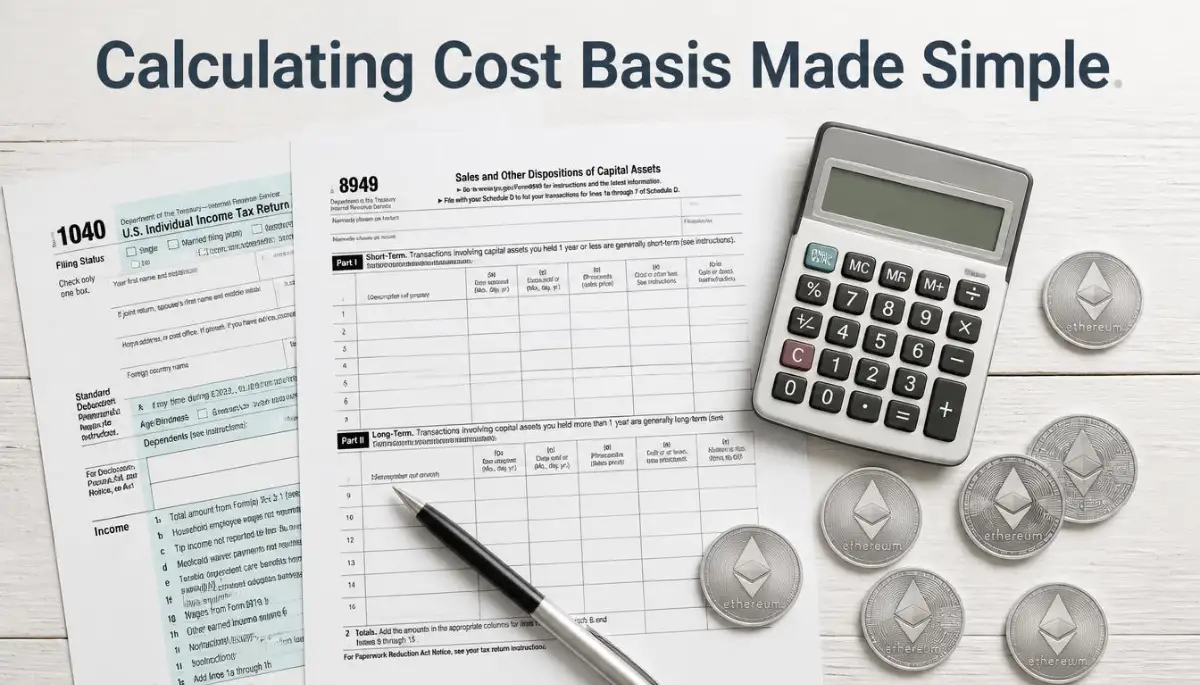
Before you can calculate your gains or losses, you need to find your cost basis. This is the starting point for every single tax calculation.
Your cost basis is simply the total amount of money you spent to acquire the cryptocurrency. This includes the purchase price of the asset plus any transaction fees you paid.
If you received the crypto through a trade, your cost basis is the fair market value of the asset at the exact time of the swap. Keeping track of this number is the most important part of the entire process.
A Simple Example of Cost Basis in Action
Let us look at a basic example to see how this works in real life. Imagine you bought a fraction of an asset for five hundred dollars, and you paid a five-dollar transaction fee.
In this case, your total cost basis for that specific asset is five hundred and five dollars. A few months later, you decide to sell that exact same asset for eight hundred dollars.
To find your capital gain, you subtract your cost basis from your final sale price. Your calculation would look like this: eight hundred dollars minus five hundred and five dollars.
This leaves you with a total taxable capital gain of two hundred and ninety-five dollars. By understanding this simple math, you can easily calculate any trade in your portfolio.
Short-Term vs. Long-Term: Why the Clock Matters
Not all capital gains are taxed at the same rate. The amount of tax you pay depends heavily on how long you held the asset before selling.
Most tax systems split these into short-term and long-term capital gains. Knowing the difference can save you thousands of dollars over time.
As you can see from the table, holding your assets for a longer period is highly beneficial. If you sell an asset after holding it for less than a year, you will pay a higher rate.
If you can hold your assets for just one day past the one-year mark, you qualify for the lower rate. This is one of the easiest ways to keep more of your investment profits.
Step-by-Step Guide to Calculating Your Taxes
Now that you know the basic concepts, let us look at the actual steps to prepare your report. Following a systematic process will help you avoid mistakes and reduce stress.
Step 1: Collect Your Transaction History
The first and most important step is to gather all your data from every platform you used. This includes centralized exchanges, decentralized wallets, and even offline storage.
Most exchanges allow you to download a complete history of your transactions as a CSV file. Make sure you get the records for the entire tax year, leaving no gaps.
If you used decentralized wallets, you can copy your public address and use a blockchain explorer to view your history. Keeping these files organized in a single folder will save you hours of frustration.
Step 2: Match Your Trades and Swaps
My Personal "Cheat Sheet" for Matching Trades: If you’re doing this manually, I highly recommend using the FIFO (First-In, First-Out) method. It’s the most common way tax offices look at trades. Imagine your crypto is in a physical line; the first "coin" you bought is the first one you sell. It keeps your records clean and much easier to explain if you ever get a question from the tax department.
Once you have all your data, you must match your purchases with your sales. This can get tricky if you bought the same coin at different times and prices.
To solve this, you need to choose a specific accounting method, such as First-In, First-Out (FIFO). This method assumes that the first coins you bought are the first ones you sold.
Using a consistent matching method is essential for keeping your calculations accurate and legal. If you have hundreds of transactions, using specialized tax software can automate this step for you.
Before we look at the next steps, watching a quick video can make these calculations much easier to visualize.
This video walk-through shows exactly how to track your crypto transactions to avoid errors on your tax forms.
Step 3: Calculate Your Net Capital Gain or Loss
After matching your transactions, you must calculate the gain or loss for each individual trade. Once you have those numbers, you simply add them all together.
This will give you your net capital gain or your net capital loss for the entire year. If your total gains are larger than your losses, you have a net gain that is subject to tax.
If your total losses are larger, you have a net loss that you can use to your advantage. Knowing this final number tells you exactly where you stand with the tax office.
How to Use Losses to Lower Your Tax Bill Legally
Many traders do not realize that realizing a loss can actually be a highly effective financial strategy. This process is often called tax-loss harvesting.
If you are holding assets that have dropped in value, you can sell them to lock in a capital loss. You can then use this loss to offset any capital gains you made during the year.
For example, if you made a thousand dollars of profit on one asset but lost a thousand dollars on another, your net taxable gain is zero. This simple strategy can dramatically reduce your tax liability.
Pro Tip: I learned this the hard way during my second year of trading. I had some major losses on a token that completely crashed, but I refused to sell it because of my pride. When I finally realized I could sell it to offset my other gains, I saved over a thousand dollars on my tax return.
Make sure you understand the specific rules in your country regarding this strategy. Some regions have wash-sale rules that prevent you from buying the same asset back immediately after selling it for a loss.
Common Myths About Crypto Taxes Debunked
There is a massive amount of misinformation online when it comes to reporting digital assets. Believing these myths can lead to severe penalties and unnecessary stress.
Let us clear up some of the most common misunderstandings so you can stay safe and compliant.
Myth 1: The Tax Office Cannot Track My Wallet
Many people believe that because crypto is decentralized, tax agencies have no way of knowing about their trades. This is a highly dangerous assumption to make.

Most major exchanges share user data directly with government tax agencies. Furthermore, public blockchains are completely transparent, meaning anyone can view the transaction history of any wallet.
Tax offices now use advanced software to track digital assets across different wallets and platforms. It is always best to assume they can see your transactions and report them honestly.
Myth 2: Swapping One Crypto for Another is Not Taxable
Another common belief is that you only owe taxes when you cash out your crypto into traditional government currency. This is completely false.
Swapping one digital asset for another is treated as a sale followed by a purchase. You must calculate the fair market value of the asset at the time of the swap to determine your gain or loss.
Treating every swap as a taxable event will keep your records clean and protect you from unexpected audits.
Final Steps for Filing Your Tax Return
Once you have calculated your net gains and losses, you are ready to file your return. Make sure you use the correct forms specified by your local tax authority.
In many countries, you will need to fill out a specific schedule for capital gains and attach a detailed list of your transactions. Double-check all your numbers to ensure they match your exchange records.
If you feel overwhelmed at any point, do not hesitate to consult a professional tax advisor who specializes in digital assets. Paying for expert help can give you complete peace of mind and protect your hard-earned money.
Taking control of your taxes might seem difficult at first, but it is a necessary step on your financial journey. By staying organized and following these simple steps, you can conquer tax season with ease.
Advanced Methods to Optimize Your Tax Plan
Many retail investors only think about taxes when the filing deadline is close. However, waiting until the last minute often means you miss out on legal tax-saving opportunities.
By using advanced tracking methods throughout the year, you can actively manage your liability. This approach helps you make smarter trading choices and protects your hard-earned profits.
Choosing Your Asset Matching Strategy Wisely
Most traders default to the First-In, First-Out (FIFO) method because it is easy to understand. Under this method, the tax office assumes you sold your oldest assets first.
However, in many tax jurisdictions, you can use other methods like Highest-In, First-Out (HIFO). This specific method allows you to match your sales against your most expensive purchases.
By using HIFO, you can minimize your taxable gains for the current year. To use this strategy legally, you must keep highly accurate records for every single transaction.
Why Real-Time Transaction Logging Saves Money
Waiting until the end of the year to download CSV files from your exchanges is a recipe for errors. Exchanges sometimes go out of business, or they might limit how far back you can access your history.
A better approach is to use a portfolio tracker that connects to your wallets through secure read-only APIs. This setup calculates your cost basis in real time after every single trade.
Knowing your current tax standing allows you to make quick decisions about selling assets for a loss. It takes the guesswork out of portfolio management and eliminates tax season panic.
If you want to keep your wider financial life just as organized, you need clear systems. Managing digital assets is very similar to organizing personal finance.
If you want to set up better financial frameworks, you should look into smart budgeting methods for self-employed pros with unstable income for helpful advice on cash flow. Using structured systems across all your finances will help you stay stable and secure.
The Tax Impact of Stablecoins and Liquidity Pools
A common trap for many investors is assuming that stablecoins are exempt from tax calculations. Because stablecoins are pegged to the value of fiat currency, people think swaps do not trigger gains.
However, the tax office views stablecoin swaps as a disposal of property. If the price of a stablecoin deviates even slightly from its peg, you can experience a taxable gain or loss.
Additionally, entering your assets into decentralized liquidity pools counts as a trade in many regions. You are technically swapping your tokens for liquidity provider (LP) tokens.
This swap triggers a taxable event based on the market value of your assets at that exact moment. Understanding these technical rules is essential to avoiding massive reporting errors.
If you use online tools to track these complicated DeFi transactions, platform speed is incredibly important. Having a slow connection can lead to lost data or missed updates.
Just like knowing why hosting server location can make or break your website speed, choosing fast and reliable tax platforms ensures you can access your transaction history instantly. Keep your digital workspace optimized to save both time and energy.

Hidden Traps and Costly Mistakes to Avoid
When dealing with digital assets, even minor mistakes can lead to major issues with the tax office. Many traders face audits simply because they did not understand the reporting rules.
These errors can result in expensive penalties, interest charges, and unnecessary stress. Let us look at the most common pitfalls so you can protect your financial future.
Ignoring Small Network Fees and Gas Costs
Every time you move assets on a blockchain, you must pay network fees, commonly known as gas. Many people ignore these small fees because they seem minor.
However, if you make hundreds of trades, these fees can add up to thousands of dollars. In most countries, you can add these fees directly to your cost basis or deduct them from your sales price.
Failing to track these fees means you are artificially inflating your taxable gains. You are essentially paying more tax than you legally owe.
Confusing Wallet Transfers with Taxable Sales
Another massive mistake is failing to label your transactions correctly before filing. When you transfer assets between your own wallets, it is not a sale.
However, automated tax software often flags these transfers as disposals if you do not link your wallets. This error can make it look like you sold your assets for a massive profit.
You must manually verify that every self-transfer is labeled correctly in your records. Otherwise, you might end up paying taxes on transactions that should be completely tax-free.
If you run your investment activities like a business, you might also be missing out on other legal write-offs. Discover smart tax deductions for home-based solopreneurs to see if your home office setup can lower your overall tax burden. Combining your investment strategies with smart business planning can greatly improve your bottom line.
Misreporting Hard Forks and Free Airdrops
Receiving free tokens through an airdrop or a hard fork feels like getting free money. However, tax authorities do not view them as free gifts.
Instead, they treat airdrops as ordinary income at the exact moment you receive them. The value of the tokens is calculated based on their fair market price on that day.
If you hold those tokens and sell them later, you will also owe capital gains tax on any increase in value. Failing to report airdrops as regular income can lead to penalties for underreporting your earnings.
Neglecting On-Chain Security and Platform Vulnerabilities
Managing your transactions online requires high levels of caution. If you use unsecured devices, your financial data and assets are at serious risk.
Using public networks to access your portfolios is a major mistake. For general digital safety, you should learn how to block smart TV tracking to protect your entire home network from modern data collection risks. Keeping your digital environment private is key to keeping your financial data secure.
Your Path to Stress-Free Tax Management
Taking control of your transaction history might seem difficult, but the mental relief is worth the effort. Once you have a clear tracking system, tax season stops being a source of fear.
Instead of worrying about audits, you can focus on building your wealth. You can make trading decisions based on logic rather than panic.
Dealing with complex financial planning can sometimes feel completely overwhelming. we offer useful tips on overcoming college burnout that can help you refresh your mind and handle tough tasks. Remember to take breaks to keep your mind sharp and focused.
When discussing your tax returns with professional advisors, clear communication is everything. You can read our guide on active listening hacks for professionals to improve your discussions and get better results. Working with experts is much easier when you can explain your situation clearly.
To make sure you are fully prepared, you can refer to the official IRS Digital Assets Guidelines to see how the government tracks these assets. You can also look at the HMRC Cryptoassets Manual for international perspectives on asset management. Finally, using a trusted platform like the CoinTracker Tax Resource Center can help you automate the entire calculation process.
I used to dread tax season, but taking control of my records changed everything for me. My personal journey taught me that staying organized is the ultimate key to financial peace of mind. I highly encourage you to set up your tracking system today so you never have to face tax panic again.
Answers to Your Toughest Crypto Tax Questions
Do I owe taxes if I only bought crypto and held it?
No, simply buying and holding digital assets does not trigger a taxable event. You only owe capital gains tax when you sell, trade, or spend your assets. As long as the assets remain in your wallet, their rising value is not taxed.
How are lost or stolen cryptocurrencies treated by tax laws?
In many regions, you can no longer deduct lost or stolen digital assets as personal casualty losses. This means if you lose your private keys or fall victim to a hack, you might not get any tax relief. Always keep your private keys secure to prevent irreversible financial losses.
Are stablecoins tax-free because their price does not change?
No, stablecoins are treated as property just like any other cryptocurrency. Swapping stablecoins for other tokens or fiat currency is a disposal of property and must be reported. Even minor changes in the stablecoin price can result in a taxable gain or loss.
Can I use stock market losses to offset my crypto capital gains?
Yes, in most tax jurisdictions, capital losses from one type of asset can offset capital gains from another. You can use your stock market losses to lower your taxable crypto gains, and vice versa. This makes general portfolio tracking highly beneficial for your overall tax strategy.
What happens if I fail to report my crypto transactions?
Failing to report your transactions can result in severe financial penalties, interest charges, and audits. Tax authorities use advanced blockchain tracking tools and share data with major exchanges. Reporting your trades honestly is the best way to avoid legal trouble and protect your peace of mind.
Disclaimer: This article is for informational purposes only and does not constitute professional tax, legal, or financial advice. Crypto tax laws vary significantly by country and region, and they are subject to constant change. Please consult with a qualified certified public accountant (CPA) or a professional tax advisor to address your specific financial situation.