
The Wet Couch and the Big Roommate Misunderstanding
If your roommate’s expensive MacBook gets soaked by a leaking pipe today, do you think your renters insurance will pay for it? Most people say 'yes,' but they are dead wrong. I learned this the hard way when a ceiling leak turned into a $2,000 argument. Unless you have the right names on your paperwork, your insurance company won't give your roommate a single dime. Let’s make sure you aren't leaving your stuff—and your friendship—at risk.
That single mistake turned our happy, peaceful apartment into a silent zone of awkward tension and unsaid blame. He had to pay thousands of dollars out of his own pocket to replace his school and work gear while I carried a heavy weight of guilt.

This is a silent nightmare that happens to thousands of unsuspecting roommates every single day when a sudden fire, theft, or pipe burst occurs. People move in together to save money on rent, but they rarely talk about who pays if disaster strikes.
The stress of trying to figure out insurance rules while dealing with water damage or a break-in can make anyone feel completely helpless. It feels like the insurance system is built to confuse you rather than help you protect your home.
Fortunately, you do not need to be a legal expert to keep your home and your roommate's possessions safe from sudden financial ruin. Let us look at how you can fix this dangerous coverage gap before something bad actually happens.
Decoding Your Policy: Who Actually Gets Coverage?
🛑 The Roommate Insurance Cheatsheet
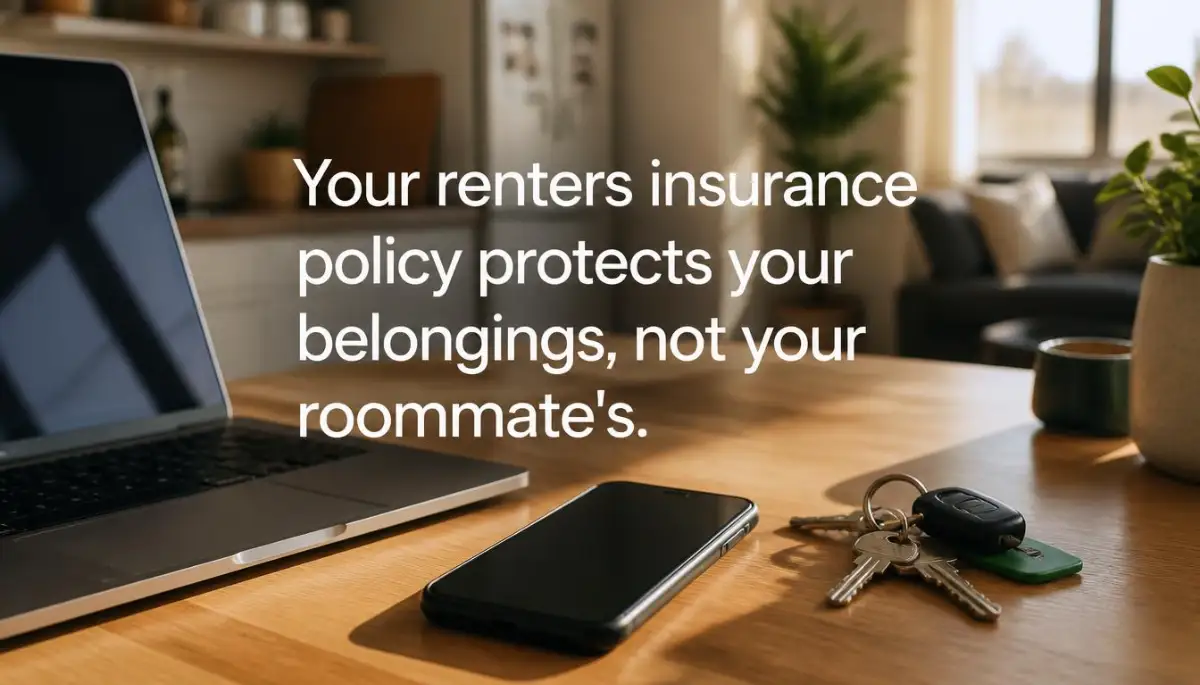
- Check the Names: If your roommate’s name isn't on the policy, their stuff isn't covered.
- Separate is Better: Getting your own individual policies is the best way to keep your insurance record clean.
- Film Your Stuff: Take a 2-minute video of your room today. It’s the easiest way to prove what you own if you ever need to file a claim.
- Replacement Cost > Cash Value: Always choose "Replacement Cost" coverage so you can buy brand new items instead of getting a small check for "used" gear.
To understand renters insurance, we have to look closely at how insurance companies define a policyholder. Standard insurance contracts are written to protect the specific person who signs the document and pays the premium.
If your name is the only one on the policy, the insurance company views your roommate as a legal stranger. Their computer, their furniture, and even their clothes are completely invisible to your insurer.
This means that if a thief breaks into your shared living room and steals both of your gaming consoles, only yours will be replaced. Your roommate will have to absorb the full financial loss of their stolen console entirely on their own.
Myth vs. Reality: The Roommate Insurance Trap
- Myth: "We live together, so we are one household in the eyes of the insurance company."
- Fact: Insurance companies treat roommates like total strangers. No name on the policy = No coverage for your stuff.
- Myth: "My landlord’s insurance covers my couch if the building burns."
- Fact: The landlord only insures the walls and the roof. Everything inside the apartment belongs to you, and protecting it is 100% your job.
Why Bloodlines Matter in the Insurance World
There is one major exception to this rule that surprises many young renters. If you live with someone who is related to you by blood, marriage, or adoption, they are often automatically covered by your policy.
For example, if you share an apartment with your sibling, your renters insurance policy will typically protect their belongings too. However, this automatic benefit does not extend to unmarried partners, friends, or random roommates.
For non-related roommates, the insurance company requires a separate agreement or a completely separate policy to offer any protection. It is highly risky to assume everyone in the apartment is safe just because one person pays an insurance bill.
The Two Paths to Roommate Property Protection
To solve this shared apartment dilemma, you and your roommate have two main choices. You can either share a single joint policy or buy two separate individual policies.
Let us look at a simple comparison table to see how these two options match up against each other.
Exploring the Shared Joint Policy Route
Some insurance companies allow unrelated roommates to buy a joint renters insurance policy together. This means both of your names are written on the contract, and both of your belongings are covered under one roof.
While this sounds like the easiest solution, it comes with several hidden complications that you need to consider. First, if your roommate makes a claim for a stolen bike, that claim goes onto your permanent insurance record too.
This joint claim history can make your future insurance premiums much more expensive when you move into your own place later. Additionally, if you need to buy a car later, a poor insurance record can hurt your auto rates.
Understanding how shared financial files affect your future is just as important as knowing why first-time personal loans fail due to bad credit patterns. Your insurance record is a permanent file that lenders and insurers look at for many years.
Managing the Coverage Limit in a Shared Policy
If you do choose to share a joint policy, you must increase your total personal property coverage limit. Most basic renters insurance policies default to a limit of fifteen thousand dollars for personal items.
While fifteen thousand dollars might cover your own items, it is rarely enough to cover the combined belongings of two active adults. You must calculate the total value of both of your wardrobes, electronics, furniture, and kitchen supplies together.
If you underestimate this total value, you will both face a painful financial shortage if the entire apartment burns down. Increasing your coverage limit is usually very inexpensive, often costing just a few extra dollars each month.
The Cleanest Path: Individual Renters Policies
For most roommate situations, the absolute best option is for each person to carry their own separate renters insurance policy. This completely separates your financial records and prevents any future arguments about claims or payments.
If your roommate suffers a loss, they file a claim directly with their own insurance company without involving you. Your premium stays safe, your record stays clean, and your friendship remains intact.
Carrying your own policy also means you get your own dedicated liability coverage. Liability coverage is highly important if a guest slips on a wet floor in your kitchen and decides to sue the household.
If you want to understand how a single claim can affect your insurance score for years, this clear breakdown is a must-watch.
Having separate policies also makes moving out incredibly simple and stress-free. When your lease ends, you can simply call your insurer and transfer your policy to your new address.
Your roommate does the same with their policy, and neither of you has to cancel a shared contract or argue over refund checks. It is a highly professional way to handle a shared living arrangement.
How to Calculate the Value of Your Shared Space
Before you buy any policy, you must know exactly how much your belongings are actually worth. Most people heavily underestimate the replacement cost of their daily items.
The "Coffee Money" Math
Did you know that adding $10,000 extra coverage to a policy usually costs less than $2 a month? That is cheaper than a single cup of coffee. If you and your roommate split the cost of a joint policy, you might save money, but you lose your privacy. If your roommate makes a claim for a stolen bike, your insurance price might go up for the next 5 years. Always weigh the $2 savings against the long-term cost.
Think about your clothes, your bed, your television, your kitchen pots, and your winter coats. If you had to buy all of these items brand new tomorrow, the total cost would surprise you.
Lenders and insurers use detailed calculations to assess risk, much like how banks review smart budgeting methods for self-employed pros with unstable income before approving credit. Taking a clean, organized inventory of your assets is the best way to ensure you buy the correct amount of coverage.
Creating a Quick Digital Home Inventory
The easiest way to value your stuff is to walk through your apartment with your smartphone and take a detailed video. Open your closets, document your electronics, and show the labels of any high-value items.

Save this video to a secure cloud storage account so you can access it if your phone is ever lost or destroyed. If you ever need to file an insurance claim, this video will serve as undeniable proof of what you actually owned.
Ask your roommate to do the exact same thing for their own bedroom and their shared living area items. Having these files ready makes the entire insurance claims process incredibly smooth and fast.
A Pro Tip From My Journey I once tried to share a policy with a roommate to save five dollars a month, but we ran into massive trouble when he moved out early. My advice is to always get your own separate policy so you keep your claim history completely clean and independent.
What About Shared Common Area Furniture?
Another common point of confusion is who owns the shared furniture in the living room or kitchen. If you bought the sofa together, or if one of you brought the dining table, who gets the insurance payout?
Typically, the person who actually purchased the item is the only one who can claim it under their policy. If you split the cost of a couch fifty-fifty, things can get highly complicated during a claim.
To avoid these headaches, it is best to assign ownership of specific shared items to one person from the very start. For example, you buy the couch, and your roommate buys the television.
This clean division of property makes it incredibly easy to assign items to your respective insurance policies. If a fire damages the living room, you claim the couch on your policy, and your roommate claims the television on theirs.
This simple strategy keeps your claims clean and prevents any disputes with claims adjusters over joint ownership. It is a smart way to manage your apartment life without unnecessary legal stress.
Taking these basic steps will give you the peace of mind to enjoy your shared apartment to the absolute fullest. You can sleep easily knowing that both you and your roommate are fully protected from life's unexpected surprises.
Smart Strategies for Long-Term Roommate Coverage Harmony
Moving into a shared home is an exciting milestone, but it requires active management to keep things running smoothly. To protect your finances over the long run, you need to think beyond the basic paperwork of your lease agreement.
A brilliant way to establish long-term coverage harmony is by drafting a simple, informal roommate contract. This document does not need to be written by an expensive lawyer to be highly useful for your daily peace of mind.
You can simply write down who owns each major appliance, who is responsible for paying the insurance premiums, and how you will handle deductible fees if you ever need to file a claim. Putting these expectations in writing helps you practice active listening hacks for professionals to prevent silly house disputes before they even start.
Another expert secret is to review your policy coverage limits every time one of you purchases a major piece of shared technology. For instance, if you split the cost of a high-end sound system or a premium projector, your standard policy might not cover its full replacement cost.
Insurance providers often place strict sub-limits on expensive electronics, jewelry, or sports gear. Checking these limits ensures you do not get a nasty surprise from your adjuster after a break-in or a fire.
If you are a student living away from home, you should check if your parents' homeowners insurance policy covers your stuff. Some homeowners policies extend a small percentage of personal property coverage to college students living in dorms or off-campus apartments.
For many young adults, this is a fantastic way to save money while maintaining premium protection during school. Reading through the ultimate survival guide for working college students can help you budget for other essential living expenses while keeping your housing costs low.
It is also highly beneficial to keep a shared spreadsheet of all communal purchases with their original purchase dates and approximate values. Store digital copies of your receipts in a shared cloud folder that both of of you can access at any time.
According to consumer safety data from the National Association of Insurance Commissioners, having digital receipts ready can cut your claim processing time in half. This simple habit keeps your records organized and prevents panic during a stressful household crisis.
If you are working as a freelancer or running a small business from your shared living room, standard renters insurance might not cover your professional equipment. You may need to add a small business rider to your policy to protect your work computers, inventory, and business tools.
This is especially important for individuals who are learning smart budgeting methods for self-employed pros with unstable income to keep their business assets fully secure. A separate business rider ensures that your livelihood is never threatened by a sudden domestic accident.
To ensure you get the absolute most out of your policy, make sure you understand the difference between actual cash value and replacement cost coverage. Actual cash value policies only pay out what your used items are worth today, taking depreciation into account.
On the other hand, replacement cost coverage pays out the actual amount it takes to buy those same items brand new at current market prices. Spending a tiny bit more on replacement cost coverage is a much smarter long-term strategy for protecting your apartment.

Silent Blunders That Can Wipe Out Your Shared Household Savings
One of the most painful mistakes you can make is assuming that your landlord’s master insurance policy covers your personal items. Many renters learn this lesson the hard way after a major building fire or a severe pipe burst.
A landlord’s policy is designed strictly to protect the physical building structure, the roof, and the communal hallways. It will not pay a single dollar to replace your furniture, your clothes, your food, or your expensive computer setup.
Leaving your personal protection entirely in the hands of a building owner is a dangerous financial gamble that often leads to deep regret. If a disaster strikes, you could find yourself completely homeless with absolutely no funds to rebuild your life.
Another massive blunder is allowing new roommates or sub-letters to move in without updating your insurance company. If a new person moves their belongings into your space, those items are completely unprotected unless they are added to the policy.
Worse, if that undocumented roommate accidentally starts a kitchen fire, your insurance company might deny your entire claim due to lease violations. Keeping your insurer in the dark is a quick way to void your coverage and face massive personal liability lawsuits.
You must also be careful not to ignore the liability limits on your policy when sharing an apartment with active pets or frequent social guests. If your roommate's dog bites a visitor, or if a guest gets hurt during a weekend party, you could be held legally responsible for their medical bills.
Failing to set high liability limits can leave your personal bank accounts vulnerable to collections and court judgments. If you are ever sued over a domestic accident, having strong liability coverage is your only real shield against total financial ruin.
According to legal defense research published by the Insurance Information Institute, civil lawsuits for household injuries can easily exceed fifty thousand dollars in basic medical and legal costs. Standard policies usually offer one hundred thousand dollars in liability coverage, but raising this limit to three hundred thousand dollars costs almost nothing.
Do not make the mistake of choosing a deductible that is too high just to save a few pennies on your monthly premium. If your deductible is one thousand dollars, and you suffer a five hundred dollar loss, your insurance company will not pay you anything.
Keep your deductible at a realistic level that you can actually afford to pay out of your pocket on any random day. If you struggle to maintain a basic emergency fund, you should avoid high-deductible policies entirely to protect yourself from sudden cash shortages.
This type of poor financial planning is very similar to why first-time personal loans fail when borrowers do not plan for unexpected expenses. Always build a small emergency safety net so you can handle your insurance deductible without experiencing a stressful cash crunch.
If you need fast financial relief during a tough month, look for safe emergency cash alternative routes instead of skipping your essential insurance payments. Keeping your policy active is the only way to guarantee that a temporary setback does not turn into a permanent disaster.
Your Simple Roadmap to Carefree Shared Living
Living with roommates is a beautiful way to save money, build lifelong friendships, and create wonderful memories together. By taking a few simple steps today to clarify your insurance situation, you can protect those relationships from unexpected financial stress.
Talk openly with your roommate tonight about their current coverage and decide which insurance path is best for your shared household. Having this simple conversation now is much easier than trying to resolve a massive money argument after a major disaster.
Remember to keep your policies separate, document your belongings with a quick video tour, and update your coverage whenever you purchase something valuable. These small, proactive habits will give you the confidence to enjoy your apartment life without any underlying worries.
Protecting your personal assets is a key part of becoming financially independent and building a stable future for yourself. Understanding how these protective boundaries work will keep you safe from the unspoken risks of co-signing a personal loan for family members or friends as you grow your wealth.
To help you get started right away, here is your quick action plan for tomorrow morning.
Your Next-Day Action Plan
- Step 1: Send a quick text to your roommate to confirm if they currently have their own active renters insurance policy.
- Step 2: Spend fifteen minutes walking through your apartment to film a quick video inventory of your bedroom and shared common areas.
- Step 3: Call your current insurance agent to verify your personal property limits and check your liability coverage levels.
I know how easy it is to put off organizing your insurance paperwork when you have a busy daily schedule. My own perspective changed completely when I realized that a tiny monthly payment could save me from losing everything I owned in a single afternoon. You can easily take control of your housing security today, and your peace of mind is worth far more than the price of a cheap cup of coffee.
Quick Answers to Shared Renters Insurance Questions
Can a landlord force all roommates to have renters insurance?
Yes, landlords can absolutely make renters insurance a mandatory requirement in your official lease agreement. They do this to protect themselves from liability disputes if a tenant accidentally damages the building or gets hurt on the property.
What happens to our shared policy if my roommate moves out early?
If your roommate leaves, you must contact your insurance company immediately to remove their name from the active contract. Failing to update the policy can cause massive legal complications if you need to file a claim after they have moved away.
Does renters insurance cover my roommate’s guests if they get injured?
Your liability coverage will generally protect you if a guest is injured in your shared space, but it may not cover your roommate's specific legal liabilities. Having separate individual policies ensures that both of you have your own personal liability shields to handle guest injuries.
Will my renters insurance cover my things if they are stolen outside the apartment?
Yes, most standard renters policies offer off-premises coverage, which protects your belongings even when you are traveling or commuting. According to consumer safety studies by the National Association of Insurance Commissioners, this coverage typically protects your laptop, phone, and luggage anywhere in the world.
Disclaimer: The information presented in this article is for educational and informational purposes only. It does not constitute professional legal, financial, or insurance advice. Please consult with a licensed insurance agent or financial professional to discuss your specific coverage needs and policy terms.