
The Hidden Struggle of Living a Double Life

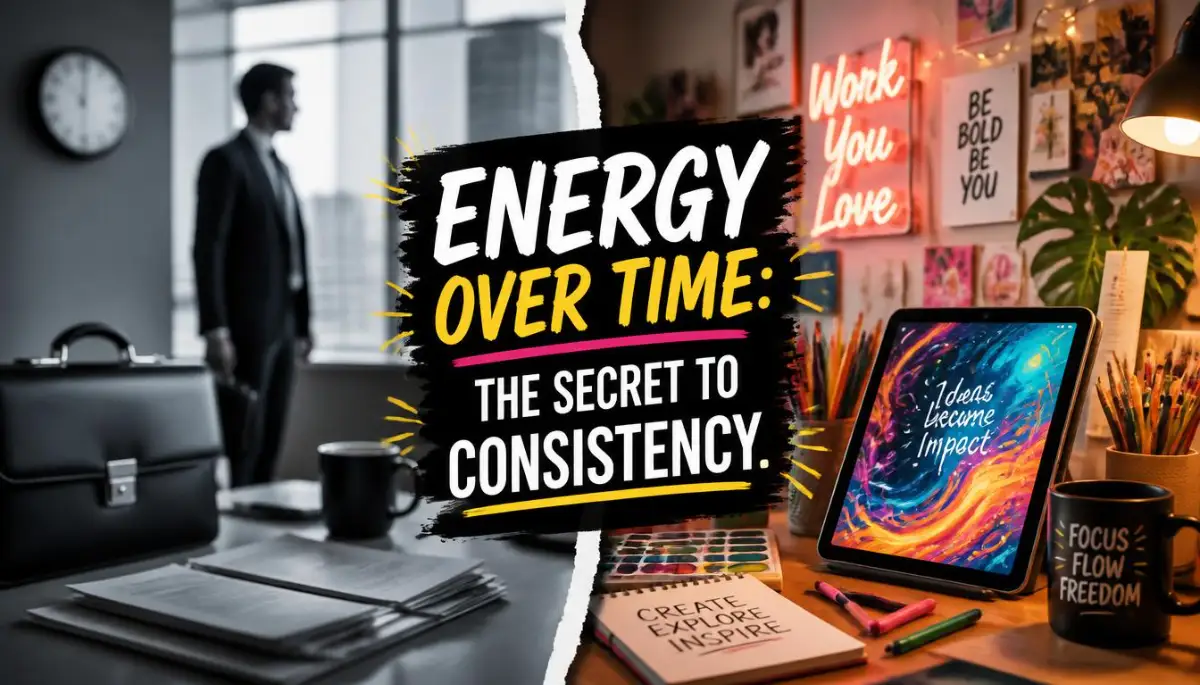
Let’s be honest. Coming home from a 9-to-5 job and trying to be creative feels like trying to start a car with a dead battery. I spent years staring at a blank screen, feeling like my brain was literally made of cement. If you’re tired of hearing "just wake up at 4 AM," this is for you. I want to show you how I actually stopped burning out and started making real progress on my projects without quitting my day job.
That was my life for a long time. I was caught between my "safe" job and my "dream" project. I felt like I was failing at both. My boss saw me yawning in meetings, and my passion project was gathering digital dust. If you feel like your brain is melting after work, you are not alone.
Most people think they just need more "time" to make their side hustle work. They buy planners and set alarms for 4:00 AM. But when the alarm goes off, they are too exhausted to move. This is the cycle that leads to total burnout and makes people quit their dreams forever.
The real problem isn't your clock. The real problem is how you handle your mental fuel. We only have a certain amount of "decision power" every day. By the time you finish your day job, your tank is often empty. Trying to force yourself to be creative when you are empty is like trying to drive a car with no gas.
It hurts when you have a big idea but no energy to chase it. I used to feel so jealous of people who did this easily. I thought they were superhuman or didn't need sleep. But then I realized they just had a better system than I did.
Rethinking the Way We Manage Our Daily Energy
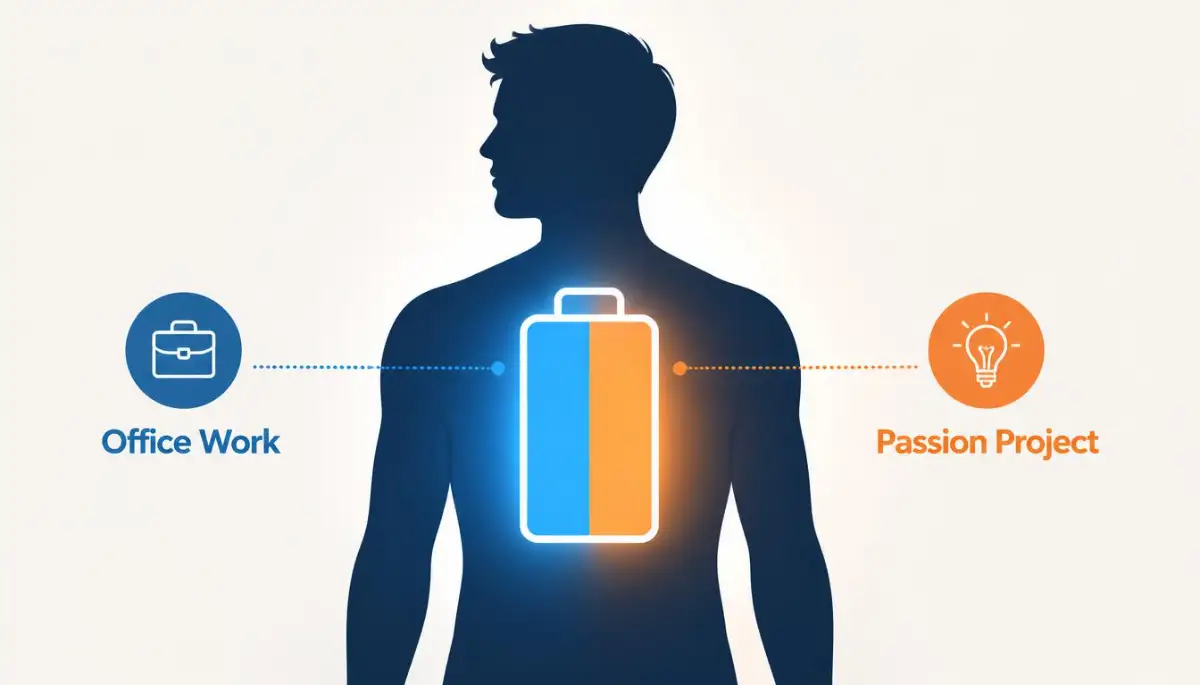
We have been told that we need to "grind" and "hustle" until we drop. This is bad advice. If you want to keep your job and build your dream, you have to be smarter than the average person. You need to look at your energy as a battery that needs careful charging.
⚡ The "No-Burnout" Cheat Sheet
- Stop Managing Time: Start managing your energy levels instead.
- The 10-Minute Gap: Use a small ritual to switch your brain from "Employee Mode" to "Creator Mode."
- Kill the Friction: Prepare your workspace the night before so you don't have to think twice.
- Embrace Imperfection: A messy draft finished today is better than a perfect idea that never leaves your head.
The Science of the "Transition Ritual"
One of the biggest mistakes I made was trying to start my passion project the second I walked through the door. My brain was still thinking about office emails and meeting notes. I hadn't switched modes yet. Scientists call this "attention residue." Part of your mind is still stuck at your desk.
I started doing a simple ten-minute walk before touching my personal laptop. I wouldn't look at my phone. I would just breathe and look at the trees. This tiny break tells your brain that the "work day" is over and the "passion time" has begun.
You need a clear line between your two worlds. Without this line, the stress from your job will leak into your creative time. You will spend your passion hours worrying about tomorrow's office tasks. That is the fastest way to feel burned out.
Protecting Your Mental Battery
Every email you answer and every small choice you make drains your battery. By 6 PM, your "willpower" is almost gone. This is why people end up scrolling on social media instead of working on their projects. It is not because they are lazy. It is because their brain is looking for the easiest thing to do.
To solve this, I stopped making big decisions at night. I prepare everything the night before. If I am going to record a video, I set up the lights on Sunday. If I am writing, I open the blank document and type the first sentence before I go to work. This removes the "friction" of starting.
The Side-Hustle Reality Check
Scheduling Based on Your Natural Rhythm
Some people are lions, and some are owls. If you try to be an early bird when you are naturally a night owl, you will fail. I tried the 5 AM club for a month and I was a zombie by noon. It didn't help my career or my passion.
Instead, I looked at when I felt most "alive." For me, it was Saturday mornings and Tuesday nights. I started protecting those specific blocks of time. I told my friends I wasn't available during those hours. This made my progress feel real instead of random.
Want to see a real example of how I organize my week to keep my stress levels low? Check out this short guide on simple planning.
The Power of the "Fifteen-Minute Rule"
When you have a big career, the idea of spending hours on a side project feels impossible. This leads to "all or nothing" thinking. You think, "If I can't work for three hours today, I won't work at all." This is a trap that kills more dreams than anything else.
I started using the fifteen-minute rule. I promised myself I would do just fifteen minutes of work on my passion project, no matter how tired I was. Usually, once I started, I would keep going for an hour. But even if I stopped at fifteen minutes, I still made progress.
Progress creates a chemical in your brain called dopamine. It makes you feel good and gives you more energy for the next day. Small wins are the secret to staying excited about your project for the long term.
My "Zero-Friction" Setup for Tonight
If you want to win tomorrow, you have to prep today. Here is my 3-step ritual to make sure I actually start working when I get home:
- The Visual Cue: I leave my laptop open on the desk with my notes already out.
- The App Block: My phone goes into "Do Not Disturb" mode automatically at 6 PM.
- The Micro-Goal: I tell myself I only have to write 50 words. Just 50. Usually, I end up writing 500.
Why Context Switching is Your Enemy
Going back and forth between your job and your passion is exhausting. Every time you switch, you lose mental power. Try to "batch" your tasks. Use one night just for planning, one night for creating, and one night for organizing.
When you focus on just one type of task, your brain gets into a "flow state." This is where the magic happens. You work faster and the work feels easier. When you are in flow, you don't feel like you are working. You feel like you are playing.
Setting Realistic Boundaries with Yourself
You cannot do everything. You have to accept that your house might be a little messy or you might miss a few Netflix shows. You have to choose your "trade-offs." I decided that my passion project was more important than knowing what happened on a reality TV show.
But you also have to set boundaries for your project. Don't let it steal your sleep. If you start cutting into your 7 or 8 hours of rest, your career will suffer. If your career suffers, your stress will go up. It’s a dangerous circle. Sleep is the best tool for avoiding burnout.
The Myth of Perfectionism
Perfectionism is just fear in a fancy suit. I spent months trying to make my first blog post perfect. I never published it. I was so worried about what my coworkers would think. I was afraid they would judge me for having a side hobby.
I finally realized that "done is better than perfect." Your passion project doesn't have to be a masterpiece on day one. It just needs to exist. Most people are so worried about their own lives that they aren't even looking at what you are doing.
Let yourself be a "beginner." It is okay to make mistakes. It is okay if your first few attempts aren't great. The goal is to learn and grow, not to be an expert immediately. When you remove the pressure to be perfect, the burnout starts to fade away.
Building a Support System
Doing this alone is hard. You need people who understand your struggle. I found a small online group of people who also had 9-to-5 jobs and side projects. We would check in with each other every week.
Just knowing someone else is also tired but still pushing forward helps a lot. It keeps you accountable. When you feel like giving up, they can remind you why you started. You don't need a huge audience; you just need a few "internet friends" who get it.
Comparing Old Hustle Culture vs. Sustainable Growth
Why "No" is Your Most Important Word
To say "yes" to your passion, you have to say "no" to other things. I had to say no to extra projects at work that I didn't really need. I had to say no to social events that felt like a chore.
Every time you say "no" to something that doesn't matter, you are saving energy for your dream. It feels uncomfortable at first, but it gets easier. People will start to respect your time because they see that you respect it yourself.
The Role of Physical Health
If you eat junk food and sit all day, your brain will be foggy. I noticed that when I started drinking more water and taking a short walk at lunch, my evening energy doubled. You don't need to be an athlete. You just need to move your body.
Your brain is a physical organ. If your body is struggling, your mind cannot create. Simple things like eating a real lunch instead of just snacking can change your whole evening. Treat your body like a high-performance machine, and it will give you the energy you need.
Dealing with "Job Guilt"
Sometimes I felt guilty for thinking about my passion project while I was at my desk. I felt like I was cheating on my employer. But then I realized that having a passion actually made me a better employee.
When I have something to look forward to after work, I am more focused during the day. I want to finish my office tasks quickly so I can get home. My passion project taught me new skills that I actually used at my job. It was a win-win situation.
Forgiving Yourself on Bad Days
There will be days when you just can't do it. Your boss yelled at you, the traffic was terrible, and you have a headache. On those days, do not force it. If you force yourself to work when you are miserable, you will start to hate your passion project.
Forgive yourself. Take the night off. Watch a movie. Go to bed early. Your project will be there tomorrow. Being kind to yourself is the only way to stay in the game for years. The people who succeed are not the ones who never stop; they are the ones who know how to rest without quitting.
Micro-Wins and the Journey Forward
Don't just focus on the big goal. If your goal is to make a full income from your passion, that will take time. If you only look at that big mountain, you will feel overwhelmed.
Instead, celebrate the micro-wins. Celebrate when you finish a paragraph. Celebrate when you learn a new tool. Celebrate when one person leaves a comment on your work. These small moments are the fuel that keeps the fire burning.
Balancing a career and a passion is like running a marathon, not a sprint. You have to pace yourself. You have to look at the ground in front of you, not just the finish line. When you focus on the next small step, the path becomes much easier to follow.
You have the power to create a life that you love. It doesn't have to happen overnight. It just has to happen one day at a time. Keep your energy high, keep your goals small, and keep your heart in it. You are doing something amazing, and it is worth the effort.
Building a System That Works While You Sleep
Once you have the basics of your side project ready, it is time to think like a manager. Many people stay stuck in the "doing" phase forever. They act like employees in their own little business. This is why they feel so tired all the time.
If you want to grow without losing your mind, you need to look at automation. Technology can do a lot of the heavy lifting for you. For example, if you spend three hours a week sending emails to clients, that is time you are not creating. Using a simple scheduling tool can give those three hours back to you.
I started using basic software to handle my social media posts and meeting invites. It felt strange at first to let a machine do the work. But it allowed me to focus on the parts of my project that I actually love. You should only spend your limited evening energy on things that only you can do.
Another pro secret is the "Friday Night Audit." Instead of jumping into work on Friday evening, I spend thirty minutes looking at what I did all week. I ask myself, "What was the biggest waste of my time?" Then, I find a way to stop doing that task or make it faster.
This helps you stay organized and keeps your stress levels low. If you are struggling with your finances while building this dream, you might want to check out some smart budgeting methods for self-employed pros with unstable income. Managing your money properly removes a huge layer of worry from your daily life.
Outsourcing the Small Stuff
You don't have to be a millionaire to get help. There are many platforms where you can find people to help with tiny tasks for a small fee. Maybe someone can edit your photos or proofread your writing.
I remember the first time I paid someone ten dollars to fix a bug on my website. It saved me five hours of frustration and hair-pulling. That was the moment I realized that my time has a real value. If you spend five hours fixing a five-dollar problem, you are losing money.
Focus on your "Zone of Genius." This is the one thing you are really good at. Everything else should eventually be handled by a tool or another person. This is how you move from having a hobby to having a real business.
When you start working with others, communication is everything. You need to be clear and direct. Learning to speak less and connect more through active listening can help you manage these small teams without drama. It makes sure everyone is on the same page from the start.
Mastering the High-Energy Sprint
Not every hour is equal. Some hours are worth ten times more than others. I found that I can do more in one focused hour on Saturday morning than in four hours on a Wednesday night.
Identify your "Power Hour." This is the time when your brain is sharp and your mood is high. Save your hardest, most creative tasks for this time. Do not answer emails or check stats during your Power Hour.
Protect this time like it is gold. Tell your family and friends that you are unavailable. Turn off your phone notifications. When you treat your work with respect, others will start to respect it too.
If you feel like you are always rushing and losing your focus, it might be a sign of deeper fatigue. Students often face this too, and you can learn a lot from overcoming college burnout with real recovery strategies. The rules for recovery are often the same whether you are in school or in an office.

The Hidden Traps That Steal Your Progress
It is easy to get excited at the start. But there are many traps that can quietly kill your passion project. One of the biggest mistakes I see is "Information Overload."
People spend all their time watching tutorials and reading books instead of actually doing the work. They feel like they are being productive, but they are just hiding from the fear of starting. I call this "The Learning Trap."
You only need enough information to take the next step. If you are building a website, don't worry about advanced SEO until you have actually written some content. Take it one piece at a time. If you move too fast, you might need a stress-free guide to move your WordPress site to a new host later because you rushed the first setup.
Another massive mistake is neglecting your health for the sake of the "grind." I used to sit for hours without moving, thinking I was being a hero. Then my back started hurting, and I felt sluggish all day.
Your physical body is the engine for your dreams. If the engine breaks, the car stops. It is very helpful to spend some time understanding how sitting for six hours affects your veins and overall circulation. A simple standing desk or a five-minute stretch every hour can save your career.
The Social Comparison Poison
We all do it. we look at someone on Instagram who seems to have it all. They have a full-time job, a perfect body, and a million-dollar side business. Then we look at our own messy desk and feel like a failure.
This comparison is a lie. You are seeing their "highlight reel," not their real life. You don't see their late nights, their failed attempts, or their stress. Comparing your beginning to someone else's middle is the fastest way to lose your motivation.
Your only competition is the person you were yesterday. If you made 1% progress today, you are winning. Stay in your own lane and focus on your own path.
Forgetting the "Why" Behind the Work
Why did you start this project? Was it for extra money? Was it for creative freedom? Was it to help people?
When the work gets hard—and it will get hard—you need a strong "Why" to keep you going. I wrote my "Why" on a sticky note and put it on my computer monitor. On the nights when I wanted to just watch TV, that note reminded me what I was fighting for.
If you lose your purpose, the work becomes a chore. And once it becomes a chore, burnout is right around the corner. Keep your dream in front of your eyes at all times.
Turning Your Vision into a Lasting Reality
Building something big takes time. It is a slow process of putting one brick on top of another. You might not see the results for weeks or even months. But that doesn't mean nothing is happening.
Think of it like a bamboo tree. For the first few years, it grows underground where you can't see it. It is building a massive root system. Then, suddenly, it shoots up eighty feet in just a few weeks.
Your passion project is building its roots right now. Every hour you spend working is making your roots stronger. When the growth finally comes, it will be fast and powerful because you did the foundation work correctly.
Creating a Sustainable Routine
The best routine is the one you can actually keep. Do not try to copy a billionaire's schedule if you have a family and a full-time job. Be honest about what you can do.
Maybe you can only work for thirty minutes on weeknights. That is fine! Thirty minutes a day is 182 hours a year. That is more than four full work weeks of progress. Consistency is much more powerful than intensity.
I learned to be flexible. If a day goes wrong, I don't give up on the whole week. I just start again the next morning. This "growth mindset" is what separates the winners from the quitters.
Staying Safe and Secure Online
As you build your digital presence, don't forget to protect yourself. Many people forget about their privacy when they are busy creating. It is a smart move to block smart TV tracking and change your settings to keep your home life private.
The same goes for using technology at your day job. If you use AI tools to help you, make sure you are doing it safely. You should learn about how to prevent public AI chatbot privacy risks at work so you don't accidentally share company secrets.
Final Steps for Your Balancing Act
You are now equipped with the tools and the mindset to handle both a career and a passion. It is not about being perfect. It is about being persistent.
Remember to take breaks. Remember to celebrate your small wins. And most importantly, remember to enjoy the process. If you are not having any fun, what is the point?
I spent a long time feeling like I had to choose between a job and a dream. I was wrong. You can have both. It just takes a little bit of planning and a lot of heart.
I really want you to know that you are capable of doing this. My own journey was full of mistakes, but I never stopped moving forward. If you start today, even with just one small step, you are already ahead of everyone who is still waiting for the "perfect" time. Trust yourself and start building.
Common Questions About Managing a Side Project
How much time should I spend on my side project each day?
There is no perfect number of hours. Some days you might have two hours, and other days you might only have ten minutes. The most important thing is to do something every single day to keep the momentum going.
Should I tell my boss about my passion project?
This depends on your company culture and your contract. If your project doesn't compete with your job, it is usually fine. However, it is often best to keep it private until it becomes successful enough to require more of your time.
What if I feel too tired after my 9-to-5 job?
Focus on energy management instead of time management. Try to get a short nap or a quick walk before you start your personal work. If you are still too tired, move your passion project time to the morning before your day job starts.
How do I stay motivated when I don't see results?
Focus on the "inputs" rather than the "outputs." Instead of worrying about how much money you made, celebrate that you finished a task. Results are often delayed, but the work you do today is always building your future.
Can I really avoid burnout forever?
Burnout comes when you ignore your body's signals for too long. If you listen to yourself and take breaks when you need them, you can keep going for a very long time. It is all about balance and being kind to yourself.
Disclaimer: The information provided in this article is for educational and informational purposes only. It does not constitute professional career, financial, or psychological advice. Always consult with a qualified professional before making major career changes or starting a new business venture. We are not responsible for any actions taken based on the content of this blog.