
The Heavy Weight of Unorganized Business Financials
Applying for a business loan is scary, but having messy paperwork is even worse. I’ve seen great businesses get rejected just because their numbers looked like a puzzle with missing pieces. You don't need to be an accountant to get a 'yes' from the bank. You just need to know exactly what they are looking for and how to clean up your records before you walk through their door.
Many hard-working business owners face this exact same wall of anxiety when they try to expand. You pour your heart, sweat, and endless hours into making your customers happy every single day. Yet, a few disorganized sheets of paper can completely stop your business growth in its tracks.
It feels incredibly unfair when your actual business is active and busy, but messy backend paperwork makes you look unprofessional to lenders. The constant fear of getting a cold rejection letter from a bank can keep you awake for hours at night.
You might feel like you need an expensive master’s degree in accounting just to get a basic bank loan approved. Fortunately, that is not true at all, and you can fix this without spending thousands of dollars.
I learned the hard way how to clean up my business books, and today I want to share that simple, stress-free path with you.
Understanding What Commercial Lenders Actually Look For
When you walk into a bank, the loan officer is not just looking at your passion or your local reputation. They are looking at your business numbers to calculate one simple thing: risk.
### 🚀 Your 'Bank-Ready' Cheat Sheet
- Weekly Check-ins: Spend 20 minutes every Friday matching your bank transactions to your receipts. It saves you weeks of work later.
- Kill the Clutter: If a customer hasn't paid you in a year, take it off your books. Banks hate 'fake' assets.
- Stay Separate: Never, ever buy your personal groceries with your business card. It’s the fastest way to lose a lender's trust.
- Know Your Ratio: Make sure your business earns at least 25% more than what the new loan payments will cost.
Lenders want to see if your business generates enough steady cash to pay back the loan principal plus interest. To do this, they rely entirely on three primary financial statements that tell the story of your business.
Let us break down these three primary documents so you can see exactly what they communicate to a bank manager.
The Balance Sheet: Your Business Worth at a Single Glance
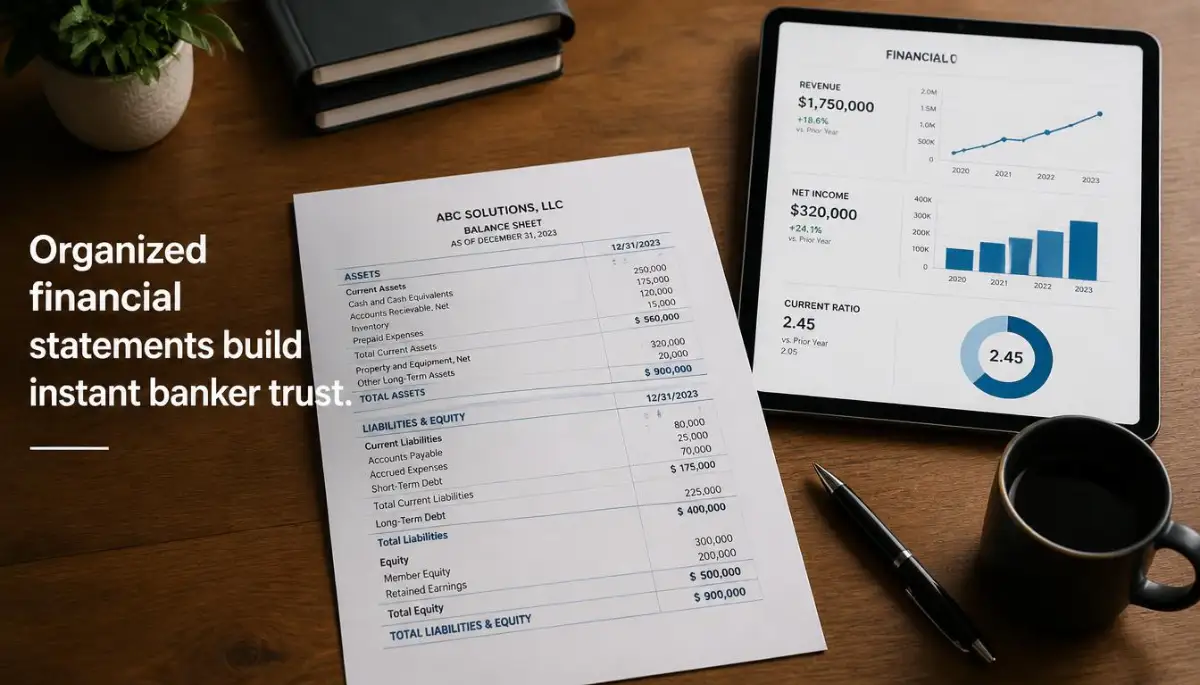
The balance sheet is a financial snapshot of your company's health at a specific point in time. It lists everything your business owns, which are your assets, and everything your business owes, which are your liabilities.
Bankers look at this document to see if your business has enough strength to survive a sudden financial downturn. If your liabilities are far higher than your assets, lenders will view your business as a high-risk gamble.
To make your balance sheet look appealing, you must ensure that your accounts receivable are fresh and actually collectable. If you have old unpaid bills from years ago listed as current assets, a smart lender will see right through it.
The Income Statement: Proving Your Consistent Profitability
Often called the Profit and Loss statement, the income statement shows your revenues, costs, and expenses over a specific period. This document tells the lender whether your business is actually making money or slowly losing it.
Lenders do not just look at your total sales; they look closely at your net profit margins after all bills are paid. A business with high sales but tiny profit margins can easily struggle to make monthly loan payments.
You must make sure that all your business expenses are categorized accurately on this statement. Grouping random expenses into a generic miscellaneous category raises immediate red flags for bank auditors.

Watch Out: 3 Red Flags That Scare Bankers Away
- The 'Miscellaneous' Dump: If more than 5% of your expenses are in a 'Miscellaneous' category, lenders think you are hiding something.
- Rounding Numbers: If every expense is exactly $500 or $1,000, it looks fake. Real business costs have cents and odd numbers.
- Negative Cash Months: One bad month is okay, but three in a row will stop your loan fast. Be ready to explain why they happened.
The Cash Flow Statement: Tracking the Actual Cash Movement
The cash flow statement tracks the actual cash entering and leaving your business bank accounts. This is different from your profit statement because it shows when the money actually arrives and departs.
A business can show a paper profit on the income statement but still run completely out of cash because of delayed customer payments. Lenders want to see a healthy, positive cash flow every single month of the year.
Showing consistent cash flow proves to the bank that you have the liquid cash ready to cover your upcoming loan installments.
Comparing Prepared vs. Unprepared Financial Books
To give you a clearer picture of how lenders view your documentation, look at this simple comparison table.
Steps to Clean and Organize Your Financial Records
Now that you know what documents are required, let us explore the actual steps to make them perfect. These are practical steps you can start taking today to prepare your business for a successful loan application.
Step 1: Reconcile Every Single Bank Transaction Weekly
Reconciliation is simply the process of matching your bank statements with your internal accounting records. If there is even a ten-dollar discrepancy between the two, a bank loan officer will question your business organization.
Make it a habit to log into your accounting platform every week and match every charge to an actual invoice. This simple routine prevents a massive, overwhelming pile-up of messy paperwork at the end of the fiscal quarter.
When your books match your bank accounts perfectly, you show the lender that you run a tight, highly professional operation.
Step 2: Separate Personal and Business Accounts Permanently
Mixing personal trips or grocery shopping with your business expenses is one of the fastest ways to get your loan denied. Lenders want to see a clear, clean line between your personal life and your business entity.
If you have used your business card for personal items, label those transactions clearly as owner draws in your books. Moving forward, commit to using your business accounts strictly for business-related purchases only.
If you want to understand why keeping your personal and business cash separate is the ultimate key to gaining financial trust, check out this highly informative guide.
Step 3: Tackle and Resolve Outstanding Accounts Receivable
If your balance sheet shows thousands of dollars in unpaid customer invoices that are over ninety days old, it looks bad. Lenders assume that you will never collect that money, and they will discount those assets heavily.

Reach out to your late-paying clients today and offer simple payment plans to get those old accounts settled. If a debt is completely uncollectible, write it off your books so your active receivables reflect true reality.
Having a smaller, realistic accounts receivable balance is far better than showing a huge, fake number that lenders will reject.
A Pro Tip From My Journey
I once made the mistake of leaving old, uncollectible customer debts on my balance sheet, thinking it made my assets look bigger. When the bank auditor questioned me about those ancient unpaid invoices, I felt incredibly embarrassed and realized that honest, clean books are always better than inflated numbers.
The Crucial Financial Ratio Lenders Calculate
Before they write you a check, lenders will calculate your Debt Service Coverage Ratio, commonly known as DSCR. This mathematical formula compares your net operating income to your proposed annual debt service payments.
Most commercial banks require a minimum DSCR of 1.25 to approve a business loan. This means your business must make at least twenty-five percent more profit than the annual cost of the loan payments.
Knowing this ratio beforehand allows you to calculate exactly how much money you can realistically afford to borrow. If your ratio is too low, you may need to focus on reducing current business debt before applying for more.
A Simple Way to Check Your Own Math
I always tell my friends to do the 'Safety Check' before calling the bank. Take your total yearly profit and divide it by the total loan payments you'll have to make. If the number is below 1.25, you are in the danger zone. I had to wait six months and pay off a credit card just to get my own ratio up to 1.3 before I finally got my first big expansion loan.
Common Myths in Business Loan Financial Preparation
There are several common misunderstandings that keep business owners from applying for loans with confidence. Let us debunk these myths so you can move forward with absolute clarity.
Myth 1: You Need to Show Huge Profits to Get Approved
Many business owners believe they must show millions in net profit to qualify for a commercial loan. In reality, lenders care far more about the stability and consistency of your income than the actual size of the business.
A smaller business with steady, predictable monthly cash flows is often more attractive to a bank than a large, highly volatile business.
Myth 2: Having Good Personal Credit is Enough
While personal credit is important for small business loans, it does not replace clean business financial statements. Lenders are loaning money to your business entity, not just to you as an individual.
Your business must prove its own ability to stand on its financial feet and pay back the requested funds.
Myth 3: Accounting Software Does All the Work for You
Modern accounting tools are fantastic, but they only work well if you input the correct data. If you categorize transactions incorrectly, your software will simply generate neat-looking, but completely inaccurate, financial statements.
Take the time to review your automated software reports to ensure every single entry makes logical sense.
Preparing Your Final Loan Package
Once your financial statements are clean, organized, and balanced, it is time to package them for the bank. Presenting your documents professionally is just as important as the numbers inside them.
Create a neat digital folder containing your balance sheet, profit and loss statement, and cash flow statement. Include your business tax returns from the past two years to show historical consistency.
Write a simple, clear cover letter explaining what your business does and exactly how the loan will help increase your profits. When you present a neat, complete loan package, you immediately stand out from disorganized applicants.
Pro-Level Tactics to Keep Your Business Books Audit-Ready
Maintaining an attractive set of business books is not a one-time project you finish right before visiting a local bank branch. To build true long-term financial security, you must treat your accounting records like a living, breathing engine.
When you establish clean weekly habits, you never have to panic when a sudden borrowing opportunity arises. You can easily keep your records clean by setting up automated cloud bookkeeping tools to track daily incoming cash.
Using modern software to automatically match your sales receipts with your bank statement line items saves you hours of manual work. Doing this regularly allows you to track your smart tax deductions for home-based solopreneurs without digging through boxes of old paper receipts.
Regular tracking also helps you identify seasonal cash patterns so you can plan your expenses before slow business months arrive. Lenders love to see consistent quarterly records because it proves that you manage your operations with deep care.
To gain additional credibility, consider having an independent certified public accountant perform a basic review of your statements every fiscal quarter. This external stamp of approval shows commercial lenders that your numbers are accurate, honest, and completely trustworthy.
The U.S. Small Business Administration guidelines emphasize that keeping verified, organized tax filings is the best way to prove consistent business earnings to traditional banks. When your internal profit sheets align perfectly with your official tax returns, a loan officer can process your application much faster.
Another excellent industry secret is to build an active, friendly relationship with local business bankers long before you actually ask them for a loan. Walk into their office, introduce your company, and ask them what specific financial metrics they prefer to see in your industry.
This simple meeting shows them that you are proactive, professional, and serious about your long-term business growth. By the time you submit your formal loan application, they will already know your face, your business model, and your financial goals.
Blind Spots That Can Instantly Ruin Your Borrowing Power
Even highly successful business owners can make small, innocent mistakes that completely ruin their chances of securing commercial financing. Understanding these dangerous traps is the first step toward protecting your hard-earned business reputation.
One major mistake is trying to hide declining sales or sudden revenue drops by moving numbers around on your statements. Bank auditors are trained to spot these discrepancies quickly, and finding hidden errors will destroy their trust in you instantly.
If your business went through a difficult season, it is always best to be completely honest about what happened. Present a clear, written plan showing how you adjusted your business operations to recover from that temporary downturn.
Another hidden danger is using your business reserves to make large, non-essential equipment purchases right before you apply for a commercial loan. Draining your active cash reserves makes your business look incredibly weak and illiquid to loan reviewers.
Lenders want to see a healthy cash cushion in your business checking account to ensure you can handle unexpected expenses. Running your business with a small cash cushion requires smart budgeting methods for self-employed pros with unstable income to keep your reserves safe.
According to financial stability research from the Federal Reserve Board, businesses that maintain healthy cash reserves are far more likely to survive economic shifts. Keeping plenty of liquid cash on hand proves to the loan underwriters that your business is highly resilient.
You should also avoid taking on high-interest, short-term merchant cash advances to solve temporary cash flow issues. These costly alternative lending options drain your daily bank accounts and make traditional commercial lenders view you as a desperate borrower.
Instead, look for safe emergency cash alternative routes that do not scare traditional bankers away. Showing that you avoid expensive, high-risk debt proves that you are a highly responsible business leader.
Taking on bad debt without a clear plan is a major reason why first-time personal loans fail as well as commercial business applications. Keep your existing liabilities low and simple so your new commercial loan application looks clean and risk-free.
Your Action Plan for Financial Confidence and Future Growth
Organizing your business finances might seem like a giant mountain to climb, but the freedom it brings is worth every single ounce of effort. When your books are clean, you are no longer operating in the dark or guessing about your true profit margins.
You gain the power to make smart, data-driven decisions that will help your business thrive for many years to come. Think of your financial statements as a clear mirror reflecting the true strength and health of your daily hard work.
Keeping your business records clean will also protect you from the unspoken risks of co-signing a personal loan for family members or running joint accounts. Your business will have its own strong financial identity, completely separate from any personal liabilities.
Understanding these steps is incredibly helpful, just like learning how to handle a job change during mortgage processing keeps your home loan safe. When you know the rules of the lending game, you can play to win every single time.
The Financial Industry Regulatory Authority educational publications suggest that early financial audit practices help small business owners build strong long-term wealth. Start by taking just one small action step today, such as cleaning up your balance sheet or setting up a weekly bookkeeping hour.
I know how scary it is to hand over your financial life to a bank inspector. My own journey changed completely when I stopped fearing the numbers and started organizing them instead. You can absolutely do this, and your business deserves this chance to grow.
Common Questions About Business Loan Financial Preparation
How many years of tax returns do commercial lenders usually want to see?
Most traditional banks require at least two complete years of business federal tax returns. They use these documents to verify that your internal financial statements match your official government filings.
Can I qualify for a business loan if my current balance sheet shows debt?
Yes, having existing debt is completely normal for active, growing businesses. Lenders simply want to see that your business income is strong enough to pay all current debts while easily covering the new loan payments.
What is the difference between a reviewed statement and an audited financial statement?
A reviewed statement involves an accountant performing basic analytical checks to ensure your numbers look reasonable. An audited statement is much more detailed, where the accountant inspects actual receipts and bank records to verify every single transaction.
Why do banks care about accounts receivable aging reports?
Banks look at these reports to see how long your customers take to pay their bills. If your customers consistently take more than ninety days to pay, the bank will worry about your daily cash flow.
Disclaimer: The information provided in this article is for educational and informational purposes only. It does not constitute professional financial, accounting, legal, or tax advice. Please consult with a certified public accountant or a qualified financial advisor before making any major financial decisions or applying for commercial loans