
The Midnight Panic: How a Tiny Mistake Almost Cost Me My Dream
You’ve spent months writing your college essay, but that tiny 'Submit' button feels like a trap. What if there’s a typo you missed? What if your voice sounds like a robot? Most students fail not because their stories are bad, but because their editing process is messy. I’m going to show you how to clean up your draft so it actually connects with the person reading it—without the late-night panic.
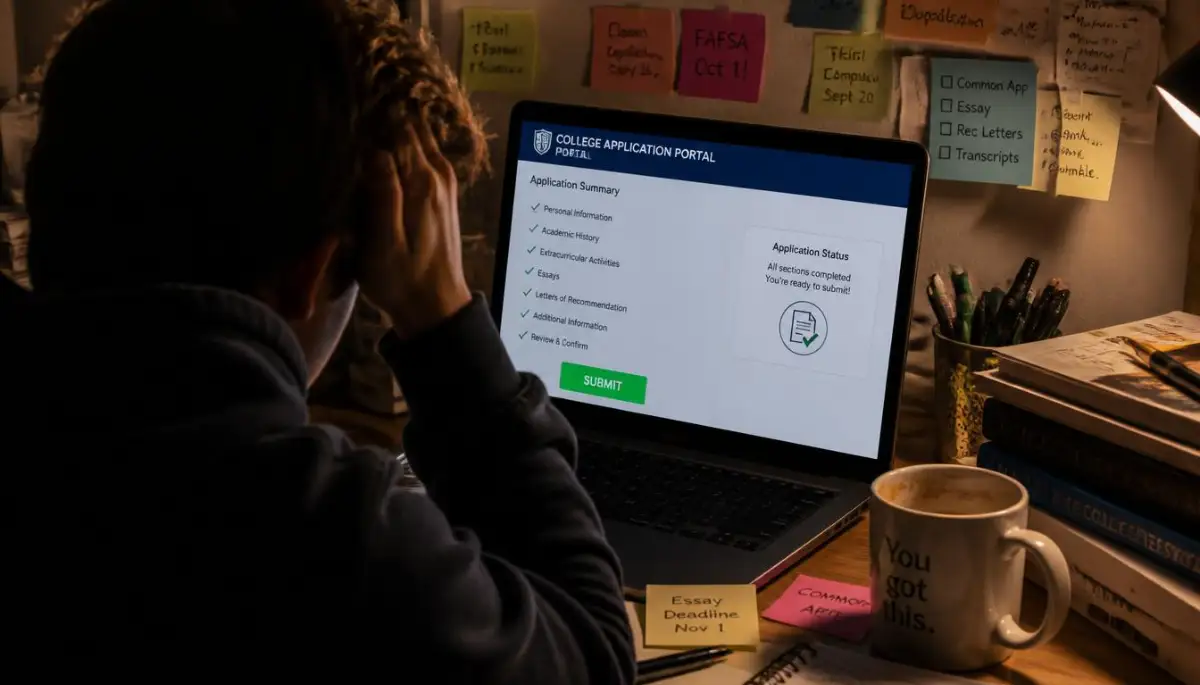
That was when I noticed a terrible mistake in the very first sentence of my draft. I had spelled my target university's name wrong. My heart dropped, and a cold sweat broke out across my forehead.
I realized I had read the draft ten times but missed this giant error. My hand was shaking as I corrected it. If I had clicked submit, my chances would have vanished. That night taught me a lesson I will never forget.
This is a fear that many high school students face. You spend months writing your story. Yet, a simple typo can make you feel like you failed.
The stress can ruin your sleep and make you doubt your own value. You might feel like you are not smart enough or that your story is too boring. This self-doubt is a quiet enemy.
But you can protect yourself from this panic. Having a clear plan of action can give you your confidence back. Let us look at how you can review your draft with fresh eyes.
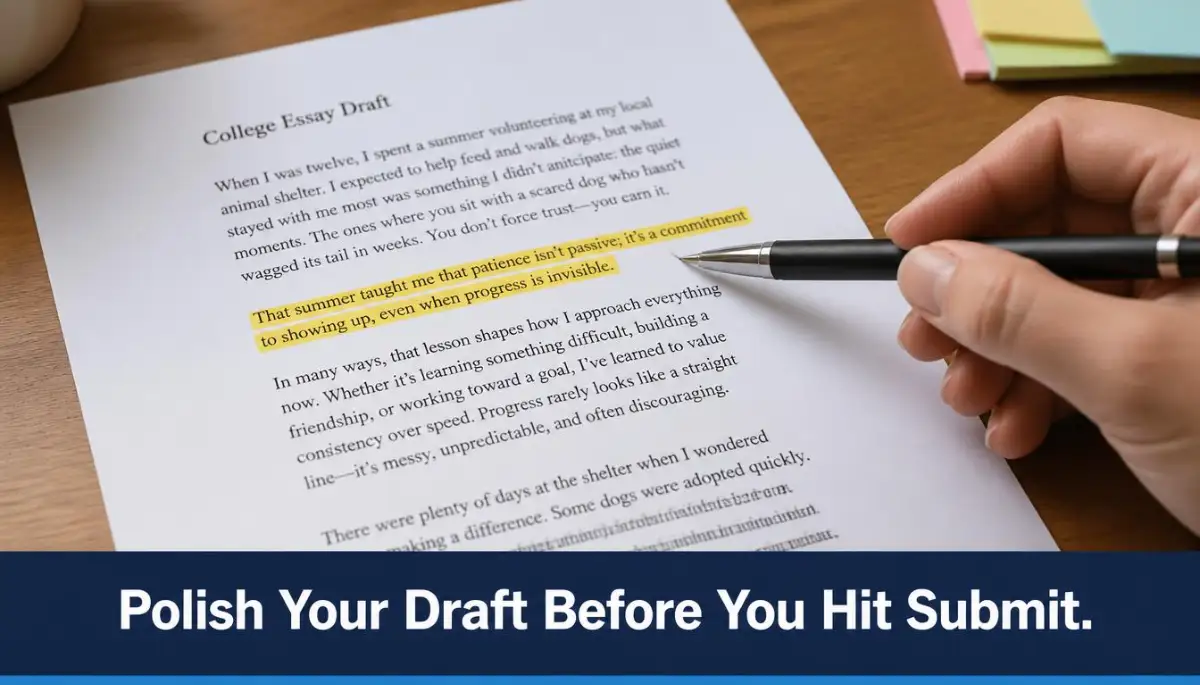
Turning Your Draft into a Masterpiece: The Structural Checklist
Testing Your Opening Hook: Does It Grab the Reader Fast?
The first sentence of your essay is like the front door of your house. If it looks boring or messy, nobody wants to come inside. Admission officers read dozens of essays every single day.
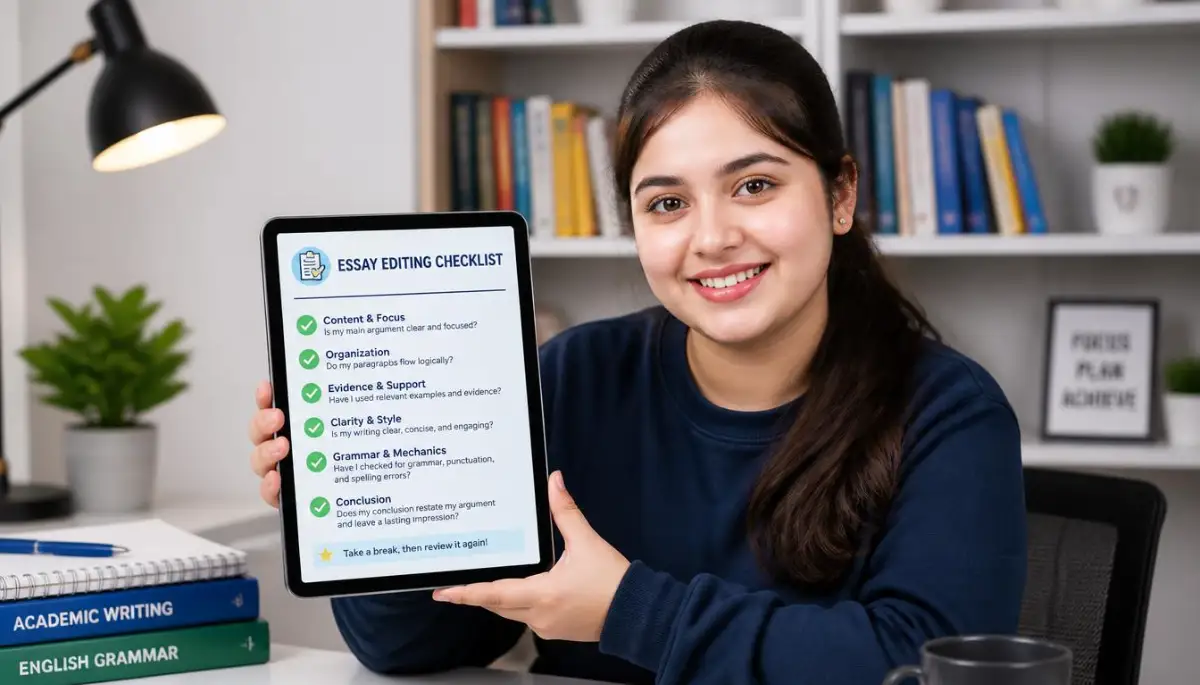
### 🛑 Don’t Hit Submit Until You Check These 4 Things:
- The Voice Test: Does it sound like you, or a textbook? If you wouldn't say it out loud, rewrite it.
- The Verb Swap: Did you remove weak words like 'very' and 'really'?
- The Prompt Match: Did you actually answer the question, or just tell a nice story?
- The Formatting Scan: Check for weird spacing errors that happen when you copy-paste into the portal.
If your opening is slow, they might lose interest before they even get to your main point. You want to start in the middle of the action or with an interesting thought. Avoid starting with generic quotes or dry facts about your life.
Think of your favorite book or movie. It probably started with a scene that made you ask questions. You want to do the exact same thing with your writing.
Instead of saying "I have always loved science," try describing a specific moment in a lab. Describe the smell of the chemicals or the sound of a bubbling liquid. This places the reader right next to you.
The Voice Check: Does This Essay Sound Like You?
Many students make the mistake of trying to sound like a textbook. They use a dictionary to find the biggest words possible. This actually makes your writing sound stiff and unnatural.
The admissions team wants to know who you are, not how many big words you know. Your writing should sound like a polished version of your natural speaking voice. If you would not say a word in real life, do not write it.
Read your paragraphs and ask yourself if a friend would recognize your voice. If it sounds like a stranger wrote it, you need to simplify. Honest writing is always more powerful than complex writing.
Focus on your real emotions and thoughts. Share your doubts, your growth, and your lessons. That is how you build a real connection with the person reading your application.
Spotting and Removing Weak Words and Clutter
We often use extra words when we write our first drafts. Words like "very," "really," "just," and "basically" do not add any value to your sentences. They make your writing weak and slow.
For example, look at the difference between two simple sentences. "I was very scared during the presentation" sounds weak. "I felt terrified during the presentation" is much stronger.
Use strong verbs instead of adding adjectives. Instead of "walked slowly," you can use "shuffled" or "crept." This makes your writing paint a clearer picture in the reader's mind.
Go through your draft line by line. Highlight every filler word and try to delete it. You will be surprised by how much stronger your sentences become.
To make your writing pop, swap these boring 'filler' words for active ones. Here is a quick cheat sheet for your final pass:
Checking the Flow: Making Sure Your Story Moves Smoothly
Your essay should feel like a smooth journey for the reader. Each paragraph needs to lead naturally into the next one. If you jump from one topic to another without a transition, the reader gets lost.
A great way to check this is to look at the first and last sentence of each paragraph. Do they connect? Is there a logical reason why this paragraph follows the previous one?
Think of your essay like a chain of events. Use transition words that show cause and effect. This keeps the reader moving forward without getting confused.
The Read-Aloud Trick to Catch Hidden Errors
Your eyes will lie to you when you read silently. Your brain automatically fills in missing words and fixes spelling mistakes in your head. The only way to stop this is to read your essay out loud.

To see this editing process in action, check out this helpful video guide. It shows you exactly how to read your essay out loud to spot mistakes you would otherwise miss.
When you speak the words, your tongue will trip over awkward sentences. If you run out of breath, your sentence is probably too long. This simple test is the best way to find clunky writing.
You can also have a friend or family member read your essay to you. Sit back and just listen to the words. You will immediately notice if something sounds strange or confusing.
Formatting Essentials: The Tech Checklist Before You Click Submit
Formatting mistakes can make a great essay look messy. Sometimes, when you copy and paste your text into an application portal, the formatting changes. Your double spaces might disappear, or your paragraphs might bunch together.
Always check the font size and style. Use standard fonts like Times New Roman or Arial. Keep the size at 11 or 12 points unless the application asks for something else.
My Personal Realization: I once spent three hours replacing simple words with big ones from an online dictionary. When I read it to my teacher, she laughed and said I sounded like a broken robot. That was when I realized that writing like a real person is the best way to connect with a reader.
Check your paragraph indents. Make sure there is a clean line of space between each paragraph. This makes the text easy to read on a computer screen.
Myth vs. Reality in College Essay Writing
- Myth: You must write about a massive life tragedy to get accepted.
- Reality: Admissions officers prefer simple, honest stories about everyday growth.
- Myth: Using complex vocabulary makes you look smarter.
- Reality: Clear, simple writing shows clear and organized thinking.
- Myth: Your essay must be exactly at the maximum word limit.
- Reality: It is much better to be 50 words under the limit with a tight, exciting story.
Aligning Your Core Theme with Your True Values
Your essay needs to show your character. Every story you tell should point back to your personal values. If you write about a sports game, the focus should not be on the score. It should be on how you handled defeat or helped a teammate.
Ask yourself what three words you want the admissions officer to use to describe you. Does your essay show those qualities? If you want to show leadership, make sure your actions in the story prove it.
Do not just tell the reader that you are hardworking. Show them through your choices and actions. This builds real trust and makes your application memorable.
Keep your focus on your own journey. The essay is about you, not about your parents, your coach, or your friends. Keep the spotlight on your own growth and learning.
Taking Your Editing Process to the Next Level
Once you have a solid first draft, the real work of polishing begins. Many students stop editing after a quick check for spelling mistakes. However, getting into top-tier universities requires looking much deeper into your writing.
This stage is where you turn a simple story into a memorable personal narrative. We will look at advanced techniques that will make your writing clean, sharp, and highly professional. These strategies are easy to use but will make a massive difference in how admissions officers read your words.
Preparing for college is not just about getting in; it is also about staying healthy and ready for the future. Reading about overcoming college burnout can help you build good mental habits early. Learning to organize your thoughts now will prepare you for the intense academic years ahead.
The Sentence Structure Audit: Creating a Rhythmic Flow
The way your sentences sound together determines how easy your essay is to read. If all your sentences are the same length, your writing will sound boring. Imagine listening to a song with only one note; you would lose interest very quickly.
To avoid this, look closely at the length of your sentences. Try mixing short, punchy sentences with longer, descriptive ones. A sudden short sentence can highlight an important point and grab the reader's attention.
For example, look at this paragraph: "I woke up early. I packed my bags. I ran to the station. I missed the train." This sounds robotic.
Instead, try: "I woke up early and packed my bags with lightning speed. Running down the street, my heart hammered in my chest. But as I reached the station, the train pulled away. I was too late."
The mix of short and long lines creates a natural movement that keeps the reader engaged. It feels alive and active.
The Secret of Backwards Proofreading
When we read our own writing from start to finish, our minds automatically skip mistakes. This happens because our brain already knows what we want to say. To break this habit, you need to trick your brain.
Try reading your essay backwards, starting with the very last sentence and moving up to the first. By doing this, you isolate each sentence from the overall story.
This forces you to look only at the grammar, punctuation, and spelling of each individual line. You will spot tiny typos, missing commas, and repeated words that you missed during your first five reads.
It is a simple trick, but it is one of the most powerful tools used by professional editors. This method aligns with standard university editing guidelines from top academic writing centers.
The Power of Active Verbs Over Passive Actions
Passive voice makes your writing feel distant and weak. Active voice, on the other hand, puts you directly in the center of the action. You want the admissions committee to see you as an active player in your own life.
Consider this passive sentence: "A decision was made by me to start a new club." It sounds cold and academic.
Now look at the active version: "I decided to start a new club." This is direct, strong, and clearly shows your personal leadership.
Scan your draft for helping words like "was," "were," "been," and "by." Often, these words indicate that you are using the passive voice.
Rewrite those sentences to show your direct actions. This simple switch will make your story feel much more exciting and personal.
Verifying the Accuracy of Your Essay Prompts
Every university has a specific set of questions they want you to answer. It is surprisingly easy to write a beautiful essay that completely ignores the prompt. This is a quick way to have your application rejected.
Before you finalize your draft, read the essay prompt carefully once again. Write down the core question on a sticky note and place it next to your screen.
Look at each paragraph and ask yourself if it directly answers that core question. If a paragraph does not support the prompt, it does not belong in your essay.
Even the most beautiful writing must be cut if it is off-topic. Staying focused shows the admissions committee that you can follow directions and write with clear intent. You can find more helpful advice on how to align your answers by checking the official guidelines on the Common Application website.
Setting Up a Collaborative Feedback Circle
You should never submit an essay without getting a second opinion. However, you must be careful about who you ask for help. Asking too many people can ruin your unique voice.
Choose two or three people whose opinions you truly respect. This could be a favorite teacher, a school counselor, or an older sibling who is already in college.
Ask them to look for specific things. One person can focus on the emotional impact of your story. Another can look for grammatical errors and sentence flow.
Communicating with admissions teams or college interviewers requires strong habits. Learning active listening hacks for professionals will help you connect with academic leaders and get the most out of your peer reviews. Use their feedback to improve your draft, but always make the final decisions yourself.
Hidden Pitfalls That Can Cost You an Admission
Trying to Write What You Think They Want to Hear
The biggest mistake students make is trying to sound like a perfect student who has never struggled. They write about winning championships or scoring top marks in class. These stories often sound fake and highly repetitive.
Admissions officers read thousands of these stories every week. They do not want to read about a perfect robot; they want to read about a real human being.
Do not hide your struggles or your failures. The best essays are often about times when things went completely wrong, and how you learned to cope.
Sharing your vulnerability shows maturity and emotional strength. It makes your application stand out from a sea of identical, boastful papers.
Getting Lost in the Background of Your Own Story
Another common trap is writing an essay about someone else. Students often write beautiful stories about a grandparent, a coach, or a teacher who inspired them.
While this is nice, the admissions committee is not admitting your grandfather; they are admitting you. If eighty percent of your essay describes another person, you have missed your opportunity.
If you write about an inspiring mentor, keep their description brief. Use their impact as a quick starting point to talk about your own actions.
Focus on how their advice changed your behavior and shaped your future choices. Keep the spotlight on yourself at all times.
Pro-Tip: The 'So What?' Test
After every paragraph you write, ask yourself: 'So what?' If that paragraph doesn't tell the admissions officer something new about your character or how you think, delete it. Every sentence must earn its place on the page. If you are just describing a sunset for two lines, you are wasting space. Keep it focused on your internal changes.
Relying Too Heavily on Software Tools
Modern spellcheckers and online grammar editors are highly useful, but they are not perfect. They can easily miss the wrong usage of words like "there" and "their" or "its" and "it's."
Even worse, some digital tools will suggest changes that ruin your natural speaking style. They might try to make your sentences sound too academic, stripping away your unique personality.
Use these tools for a basic first pass, but never let them make the final call. Your human ear is much better at understanding the emotional tone of your writing.
If you rely only on software, your essay will end up sounding cold and mechanical. Take the time to review every single suggestion with your own eyes and mind.
Just like learning smart budgeting methods with unstable income keeps you stable, planning your writing early protects you from sudden deadlines and forced mistakes. Give yourself several days to edit without rushing.
Waiting Until the Final Night to Submit
Procrastination is the ultimate enemy of a strong college application. When you write and edit an essay in a rush, you will make silly mistakes.
Your brain will be too tired to notice spelling errors, missing words, or bad formatting. Additionally, college application websites often crash on deadline nights because of too much traffic.
If you wait until the last minute, you risk missing the deadline completely. This can cause immense panic and destroy months of hard work in a single second.
Plan to finish your final draft at least one week before the actual deadline. This gives you plenty of time to deal with any unexpected technical issues or late edits.
Many first-time student steps can be tricky, similar to how first-time personal loans fail if you do not understand the rules. Avoid these errors by planning ahead and taking your time.
Your Road to Submission Success
Entering the college environment is a major transition. If you plan to work a part-time job during your studies, you should read the ultimate survival guide for working college students to manage your time well.
Every phase of life has its own complex guides, from writing essays to understanding home equity later in life. Developing great habits now will pay off for many years to come.
Take a moment to celebrate how far your writing has come. You have taken a rough draft and polished it into a strong, clear, and authentic story.
Now, double-check your formatting one last time. Ensure your name and details are correct.
When you feel ready, take a deep breath and submit your work with absolute pride. Your unique voice is ready to be heard by the world.
Clear Answers to Your College Essay Editing Worries
Should I double-space my college essay before uploading it?
Most college application portals will format your text automatically when you paste it into the box. However, if you are uploading a PDF document, standard double-spacing with a clean font is usually preferred. Always read the specific formatting rules for each school before submitting.
Is a 600-word essay too short if the limit is 650 words?
No, 600 words is a fantastic length for a 650-word limit. It is always better to have a tight, exciting story that is slightly short than a long, boring essay filled with extra words. Focus on the quality of your message rather than hitting the exact word maximum.
How many people should edit my application essay?
It is best to have only two or three trusted people review your writing. If you ask too many people, you will get conflicting advice and lose your unique voice. Choose people who understand grammar and know your personal personality well.
Can I write about a childhood event for my college essay?
You can mention a childhood event briefly, but the main focus must be on your high school years. Admissions officers want to see who you are today, not who you were ten years ago. Use the past as a quick introduction, then pivot to your recent growth and future goals.
My Final Advice to You: I remember sitting where you are now, sweating over every single punctuation mark. My advice is to trust the story you have lived and let your true self speak on the paper. Once you complete these final steps, take a deep breath and hit submit with total pride.
Reader Disclaimer : This guide is for informational purposes to help students improve their personal writing styles. College admission decisions depend on many factors beyond the application essay, including academic grades, test scores, and extracurricular activities. We do not guarantee admission to any specific institution.