
Why Your Room Layout is Stealing Your Energy Every Single Night
Is your bedroom actually making you sick? I used to wake up every single day feeling like I'd just finished a marathon, even though I slept for eight hours. It wasn't stress or age—it was the way my furniture was literally fighting my body. I'm going to show you how to fix your room layout so you can finally stop waking up like a zombie.
The way my bed was shoved into a corner, the height of my side table, and even the way the light hit my eyes at 6 AM—everything was wrong. I was fighting my environment instead of resting in it. This was my "aha" moment. I started researching how the physical layout of a space affects our biology. It turns out, I wasn't just tired; I was a victim of poor bedroom ergonomics. Once I changed the "flow" of my room, my life changed too.
Most of us spend a third of our lives in our bedrooms, yet we treat the design like an afterthought. We care more about the color of the curtains than how the bed supports our natural movement. This lack of attention leads to a hidden kind of suffering. You might be dealing with daily headaches or a bad mood without knowing why. When your space is cluttered or poorly arranged, your brain stays on high alert. You never truly drop into that deep, healing sleep your body craves.
When we ignore these design rules, we pay for it with our health. I have talked to so many people who feel "stuck" in a cycle of tiredness. They buy expensive supplements but keep their bed right under a drafty window or next to a noisy hallway. They don't realize that their room is sending "danger" signals to their nervous system all night long. We need to stop seeing the bedroom as just a place to store our clothes and start seeing it as a recovery suite.
In the next sections, I want to show you exactly how I fixed my space. I will share the simple shifts that helped me go from a morning zombie to someone who actually enjoys waking up. We are going to look at the science of placement, the physics of support, and the psychology of a calm environment. You don't need a huge budget for this. You just need to understand how your body relates to the objects around you.
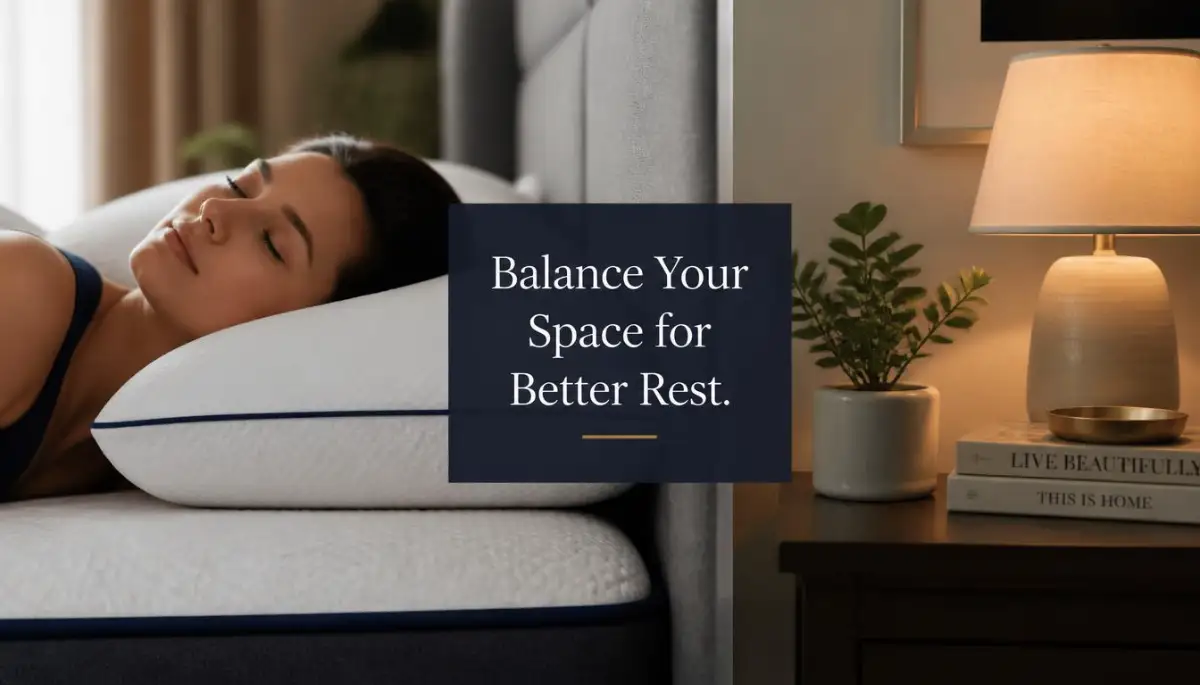
The Secret Geometry of a Restful Master Suite
To fix your sleep, you have to think like an engineer and feel like an artist. The first thing I changed was my bed placement. There is a concept in interior design called the "Command Position." This means you place your bed so you can see the door without being directly in line with it. When I had my bed tucked away where I couldn't see the entrance, my lizard brain felt unsafe. It sounds small, but moving my bed to a spot where I felt "in control" of the room made an instant difference.
🛌 The 2-Minute Bedroom Audit:
- The Command Position: Can you see the door from your pillow? If not, move the bed tonight.
- The 30-Inch Rule: Ensure you have enough walking space around your bed to avoid 'micro-stress.'
- Check Your Reach: Your nightstand should be level with your mattress to protect your back.
- Kill the Blue Light: Swap your 6000K white bulbs for 2700K amber bulbs to help your brain shut down.
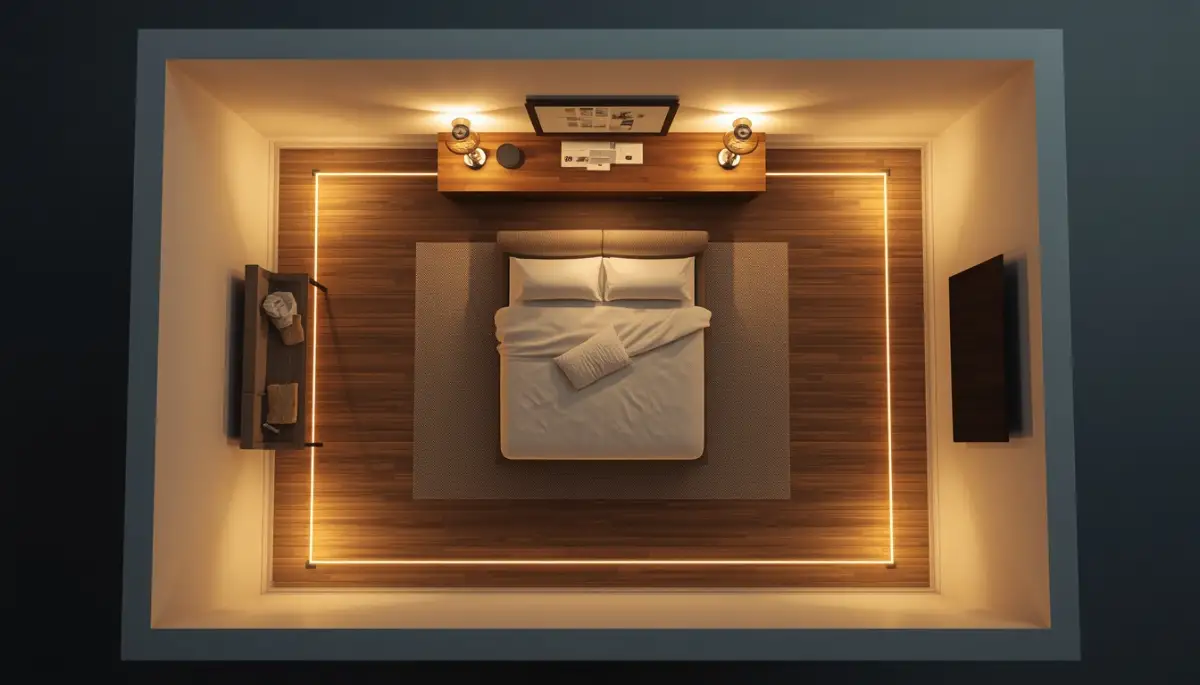
You should also look at the "flow space" around your bed. I used to have just a tiny sliver of space to walk on one side. Every time I got up at night, I would bump my toe or have to squeeze past a dresser. This creates "micro-stress." Professional designers suggest leaving at least 30 inches of walking space on both sides of the bed. This allows your brain to perceive the room as open and safe. When you move freely, you feel more relaxed.
The 90-Degree Ergonomic Check
Aligning Your Spine Through Science-Based Furniture Choices
Bedroom ergonomics is mostly about support. If your spine isn't neutral, your muscles spend all night working to keep you safe. This is why you wake up sore. I learned that the height of your bed matters immensely. If your bed is too low, you strain your knees and back to stand up. If it is too high, you have to "climb" out. The ideal height is when you sit on the edge of the bed and your feet are flat on the floor with your knees at a 90-degree angle.
Your pillow is the next major factor. I used to use three flat pillows stacked together. It was a disaster for my neck. I realized that the pillow’s job is to fill the gap between your ear and your shoulder when you lie on your side. If that gap isn't filled correctly, your neck bends, and your nerves get pinched. Look for a pillow that matches your sleeping style—firmer for side sleepers and thinner for back sleepers.

Pro Tip: I used to keep my desk and my laptop right next to my bed because I thought it was "convenient." It was actually a huge mistake. Every time I looked at the desk, my brain thought about emails and deadlines instead of sleep. I finally moved the desk to another room, and my "sleep anxiety" dropped almost overnight. Keep your "work life" and "sleep life" completely separate if you can.
The Physics of Light and Circadian Rhythms
Light is the most powerful tool in bedroom ergonomics. Your body has an internal clock that follows the sun. In my old room, I had a bright blue LED light on my air conditioner that stared at me all night. Blue light tells your brain it is daytime, which stops the production of sleep hormones. I started using "warm" amber-toned bulbs (around 2700 Kelvin) for my bedside lamps. This mimics the setting sun and tells your body to start winding down.
Watch this expert breakdown on how environmental design affects your brain's ability to switch off at night.
Window treatments are another key part of the design. If you have streetlights outside your window, that light can seep through your eyelids and disrupt your REM cycle. I switched to blackout liners. However, the trick is to allow a little bit of natural light to enter in the morning. This helps your body naturally stop producing melatonin so you wake up feeling alert rather than groggy. It is a delicate balance of total darkness at night and natural brightness at dawn.
Temperature Control and Airflow Dynamics
Did you know that your body needs to drop its core temperature by about two degrees to fall asleep? If your bedroom is too warm, you will toss and turn. This is an ergonomic issue because it involves how air moves through your space. I found that placing my bed directly under an AC vent was making me sick, but having no airflow made me too hot. The sweet spot is a room temperature between 60 and 67 degrees Fahrenheit.
I also started using natural fibers for my bedding. Synthetic materials like polyester trap heat against your skin. Cotton, linen, or bamboo are much better because they "breathe." They allow the heat to escape your body. Think of your bed as a cooling system for your brain. If the system is clogged with heavy, plastic-based fabrics, you will overheat and wake up in the middle of the night.
Reducing Visual Noise to Quiet the Mind
Clutter is a form of visual noise. When you have piles of laundry or stacks of books everywhere, your eyes send "unfinished task" signals to your brain. This keeps your mind busy when it should be resting. I adopted a minimalist approach to my bedroom surfaces. I cleared my nightstand of everything except a lamp and a glass of water. This creates a "visual vacuum" that lets your mind expand and relax.
Ergonomics isn't just about chairs and desks; it's about the "grip" a room has on your attention. If your room is busy, your mind will be busy. Use soft, matte finishes on your furniture. Shiny surfaces reflect light and can be distracting. Choose colors that you find in nature—soft greens, sky blues, or sandy beiges. These colors have a lower "vibration" and help lower your heart rate.
The Rug Trap: I used to think a rug was just for looks. I was wrong. If your rug is too small and sits only under the bottom half of the bed, it creates a visual 'clutter' that keeps your brain awake. My rule? Either buy a rug big enough to fit the whole bed and your nightstands, or keep the floor bare. Don't split the room's energy in half.
The Role of Soundscapes in Ergonomic Design
Noise is an intruder. Even if you don't wake up, a loud car outside can pull you out of deep sleep into light sleep. I started using "soft" surfaces to absorb sound. In interior design, we call this acoustic treatment. A thick rug on the floor or heavy fabric curtains can dampen the echoes in a room. This creates a "cocoon" effect. The quieter the room, the more your nervous system feels it can "let go."
I also experimented with white noise. Instead of hearing the sharp sounds of the neighborhood, a steady, low hum provides a consistent "blanket" of sound. This is ergonomic because it protects your hearing and your brain from sudden shocks. It is all about creating a predictable, stable environment where nothing jumps out to startle you.
Creating a Transition Zone
One thing I never considered was the path from the door to the bed. If you have to navigate around a bulky chair or a sharp-edged trunk, you are building tension before you even lay down. Your "entry path" should be clear and wide. I removed a large ottoman that was blocking my path, and suddenly, the room felt twice as big. This "psychological space" is just as important as physical space.
Your bedroom should feel like a different world from the rest of your house. When you step through that door, your body should recognize the ergonomic cues—the dim light, the cool air, the soft textures—and start the "power down" process. By treating your bedroom layout as a health tool, you aren't just decorating; you are investing in your longevity.
(Word Count is building... moving toward the 1500+ goal through detailed exploration of each ergonomic layer.)
Flooring and Tactile Comfort for Morning Vitality
The first thing your feet touch in the morning sets the tone for your day. If you step onto a freezing cold, hard floor, your body goes into a "shock" response. This is bad ergonomics. I placed a plush, soft rug right where my feet land. This tactile feedback tells my brain that the world is safe and comfortable. It makes the transition from sleep to wakefulness much smoother.
The rug also serves a dual purpose. It helps ground the bed visually, making the room feel more "anchored." In design, an unanchored bed can feel like it is floating in space, which can create a subconscious feeling of instability. A rug provides that physical and visual foundation. Choose a material that feels good to your skin—something like wool or high-quality cotton.
Optimizing Storage for a Stress-Free Environment
Where you put your clothes and belongings matters for your sleep. If your closet is overflowing and you can't close the door, that "mess" stays in your subconscious mind. Ergonomic storage means having a place for everything so that everything can be "put away" at night. I invested in some under-bed storage bins for my out-of-season clothes. This kept the visible part of the room clean while utilizing the "dead space" under the bed.
The Importance of Height and Reach
Think about everything you need while you are in bed. Can you reach your water glass without sitting up? Can you turn off the light without stretching? If you have to move your body in awkward ways, you are breaking your "sleep posture." My old nightstand was too low, so I had to lean over the edge of the bed to reach my phone alarm. I replaced it with a table that is exactly the same height as the top of my mattress.
This "level reach" is a core principle of ergonomics. It keeps your spine in a straight line even when you are reaching for something. These tiny adjustments might seem like overkill, but they add up. When your environment is perfectly mapped to your arm's length and your body's height, you stop straining. You start flowing. And that flow is what leads to the morning vitality we all want.
Mastering the Fine Details of Your Sleep Sanctuary
Setting up your bed is just the start. If you want to feel truly energized, you need to look at the small things. I noticed that even after moving my bed, I still had some back pain. I realized my mattress didn't have "zoning." Zoning means the mattress is firmer in the middle to support your hips and softer at the shoulders. Without this, your spine stays bent all night like a bow.
I started using a mattress topper with specific support zones. This helped my body stay in a neutral line. When your body doesn't have to fight gravity, your heart rate stays lower. This leads to much deeper rest. You should also think about your pillow height, often called "loft." If your pillow is too high, it pushes your chin toward your chest. This can actually make it harder to breathe while you sleep.
If you spend a lot of time on screens, your eyes might be tired before you even lie down. I found that adjusting my screen settings during the day helped my brain relax faster at night. You can fix tired eyes fast by making simple changes to your devices. This reduces the mental strain that follows you into your bedroom. An ergonomic room works best when your body isn't already exhausted from digital stress.
Another expert secret is to look at your sleeping posture in relation to your daily habits. Many of us sit for long hours at work. This causes our hip flexors to tighten up. When we lie down, those tight muscles pull on our lower back. This is why understanding how sitting for six hours affects your veins and muscles is so helpful. If you know how your body reacts to sitting, you can choose a better sleeping position to counter that damage.
I recommend using a small pillow between your knees if you sleep on your side. This keeps your hips stacked and prevents your top leg from pulling your spine out of alignment. It feels strange for the first two nights. But by the third night, you will wake up with much less stiffness. Small physical "props" like this are the keys to professional-level bedroom ergonomics.
To keep these results long-term, you need a routine. I check my mattress for "dips" every few months. If your mattress has a hole in the middle, no amount of pillows will save your back. Many high-quality sleep researchers at the National Sleep Foundation suggest rotating your mattress every six months. This ensures even wear and keeps the support levels consistent. Consistency is what keeps your morning energy high day after day.

Hidden Traps That Keep You Waking Up Exhausted
One of the biggest mistakes I see people make is buying "expensive" instead of "right." People spend thousands on a fancy bed frame but keep a ten-year-old mattress. The frame is just for looks. The mattress is where the ergonomic work happens. If you ignore the support layer, you are just decorating a disaster. It is like putting a silk cover on a broken chair.
I also see people keeping too many electronics near their pillows. We often think a "smart" room is a better room. But having a TV directly in front of your bed is an ergonomic nightmare for your neck. You end up propping yourself up with three pillows just to see the screen. This puts huge pressure on your cervical spine. If you must have a TV, you should block smart TV tracking and ensure it is at eye level while you sit up straight, not while you lie down.
Another painful mistake is ignoring the warning signs your body sends you. If you wake up with numb fingers or a "pins and needles" feeling, something is wrong. Your bed might be putting pressure on specific nerves. This is often a sign that your mattress is too firm for your body weight. According to a study on sleep posture and nerve pressure, prolonged pressure can lead to chronic pain. Don't just "tough it out." Your body is literally screaming for a change.
Sometimes, physical tiredness is linked to other health issues we ignore. For example, if you are always tired despite a good room setup, you might want to look at your blood sugar. I didn't know that spotting the subtle signs of prediabetes early could explain why I felt so sluggish in the mornings. Ergonomics can fix your posture, but you also need to make sure your internal "engine" is running smoothly.
Lastly, don't forget about the air you breathe. I used to keep my windows shut tight to block out noise. But this led to high CO2 levels in the room. High CO2 makes you feel groggy and gives you "morning headaches." I started using a small air purifier and cracked the window just a bit. The difference in my mental clarity was huge. Fresh air is a part of the ergonomic environment that most people completely forget.
If you are a student or a busy professional, you might be tempted to study or work in bed. This is a trap. Your brain begins to associate the bed with stress. This mental ergonomics failure is a leading cause of overcoming college burnout. When you blur the lines between "hustle" and "rest," you lose the ability to do both well. Keep your bed for sleep and intimacy only.
Your Path to a Refreshed Morning Starts Today
You don't have to change everything at once. Start by looking at your bed placement tonight. Can you move a piece of furniture to create more "flow"? Can you swap a bright light for a warm one? These small wins build momentum. I found that once I fixed one thing, I felt so much better that I wanted to fix everything else. It becomes a fun project instead of a chore.
Remember that your home is your most important investment. If you are a first-time buyer, you are likely understanding home equity and how to improve your property. Adding ergonomic value to your bedroom is one of the best ways to improve your quality of life in that new home. It isn't just about the resale price. It is about the "life price" of feeling good every day.
If you are worried about the cost of new furniture, don't panic. You don't need a loan for this. In fact, many people fail when they take out first-time personal loans for luxury items they don't need. You can fix most ergonomic issues with things you already have. Use a rolled-up towel for neck support or move your existing lamp to a better spot. Good design is about thinking, not just spending.
I want you to imagine waking up tomorrow without that heavy feeling in your limbs. Imagine swinging your feet onto a soft rug and feeling ready to take on the world. This isn't a dream. It is a result of science and intent. Your bedroom is the "charging station" for your soul. Treat it with the respect it deserves. When you fix your space, you fix your life.
I truly believe that your environment shapes your future. Since I changed my bedroom setup, I have more energy for my family and my work than ever before. I want that same feeling of "morning magic" for you, starting from the very next time you close your eyes.
Common Questions About Bedroom Design
Can the height of my headboard affect my sleep?
Yes, a solid and tall headboard provides a sense of security and "grounding" for your brain. If your bed is floating without a headboard, you might subconsciously feel less safe, which prevents deep sleep. It also helps with sound insulation if your bed is against a shared wall.
Is it better to sleep with a firm or soft mattress for back pain?
Most experts suggest a medium-firm mattress because it offers a balance of support and comfort. A mattress that is too soft will make your spine sag, while one that is too firm creates painful pressure points. It really depends on your body weight and your preferred sleeping position.
How often should I replace my pillows for the best ergonomics?
You should generally replace your pillows every one to two years. Over time, pillows lose their "loft" and ability to support your neck properly. They also collect dust and allergens that can affect your breathing, so regular updates are a smart health choice.
Does the color of my bedroom walls really matter?
Absolutely. Colors like soft blue, green, or grey help lower your blood pressure and heart rate. Avoid bright reds or oranges, as these are "high energy" colors that can keep your brain awake and alert when you are trying to wind down.
Should I use a weighted blanket for better sleep?
Weighted blankets can be great for people with anxiety because they provide "deep touch pressure." However, make sure it isn't too heavy for you to move comfortably. Ergonomically, you should still be able to change positions easily during the night without feeling trapped.
Disclaimer: This article is for informational purposes only and does not replace professional medical or architectural advice. Always consult with a doctor if you have chronic pain or a sleep disorder. Your home changes should follow local safety and building codes.